This one weird trick might cost your retirement fund billions
Mirrored from Marcus on AI for archival readability. Support the source by reading on the original site.
Part One: What’s a company worth?
How much would you buy a company for? Ten times what it made last year? A hundred times what it made last year? A thousands times what it made last year?
Microsoft’s $3.1 trillion market cap is about 25 times what it made last year; Google’s $4.6 trillion market cap is about 30 times what it made last year.
A really, really good salesperson might fool people into valuing their company at 300 times earnings. Elon Musk has been especially effective at that sort of thing, with Tesla currently trading at around 383 times earnings. Tesla isn’t priced in a way that makes sense based on how much it currently earns; its market cap can only be understood in terms of fantasies that people have about what the company might do someday.
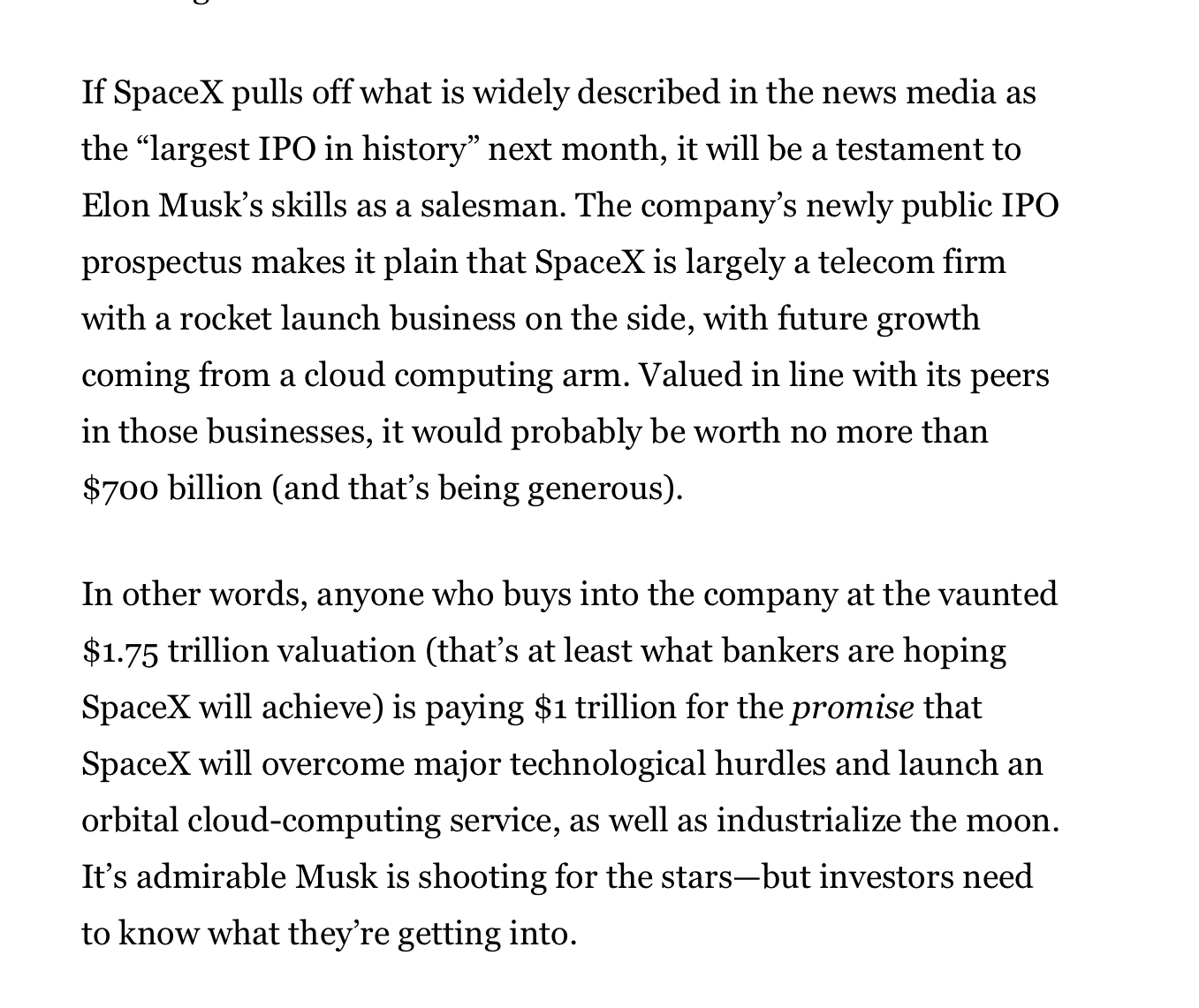
Musk is maybe about to pull off this feat of salesmanship one more time, on a massive scale, with the IPO of SpaceX. It’s really really hard to make rational sense of the valuation he is apparently expecting, as Martin Peers explained today in his newsletter from the Information:
But ok, that’s not your problem, unless you buy into the IPO. Or is it? That brings me to Part II.
Part II: The weird rule changes that could make the potential mispricing of SpaceX many people’s problem.
Many people have retirement money invested in index funds, which own stock in many companies in proportion their market values. This drives purchases of the stock for those companies that are in the index, and leads everyone who owns the index funds to have indirect ownership in the relevant companies. At SpaceX’s valuation, SpaceX de facto became a big part of the index, once the index takes it on board.
The weird trick is that S&P 500, driver of many index funds, is considering changing its rules:
As Mackintosh explains, there currently is “a requirement to make a profit and wait a year for initial public offerings to get into the flagship S&P 500”; the S&P is proposing to drop that requirement to just six months, waiving the profitability for “megacap” stocks. Many expect them to end their consultation on this next week, on Thursday May 28, with formal implementation to follow quickly afterwards.
(Also at issue is the “float”, how much of a company needs to be publicly listed before it gets indexed; SpaceX isn’t offering much of itself up, yet the index funds may take it on anyway, given the rule changes that are being considered).
Mackintosh called the proposed S&P 500 rule changes “egregious”; I agree.
Collectively, they would would mean SpaceX would go quickly into the S&P 500, even before there was clear evidence of consistent profitability—effectively forcing many mutual funds to make huge purchases—long before the dust had settled on how it really should be valued.
If it does, many people maybe stuck indirectly, via their retirement funds, buying SpaceX at a high early valuation.
Because the opening stock price seems a bit of a fantasy, they may see their holdings rapidly plummet.
Same logic may well apply to the upcoming IPOs of OpenAI and Anthropic.
If you have a mutual fund and don’t want a significant part of your holdings to flip essentially automatically into speculative, not yet proven big tech plays like SpaceX, OpenAI and Anthropic, you might want to call your congressperson ASAP to complain about this rule, and the risks it could pose to your retirement.
Discussion (0)
Sign in to join the discussion. Free account, 30 seconds — email code or GitHub.
Sign in →No comments yet. Sign in and be the first to say something.