Trump canceled AI safety testing EO after snub from tech CEOs
Mirrored from Ars Technica — AI for archival readability. Support the source by reading on the original site.
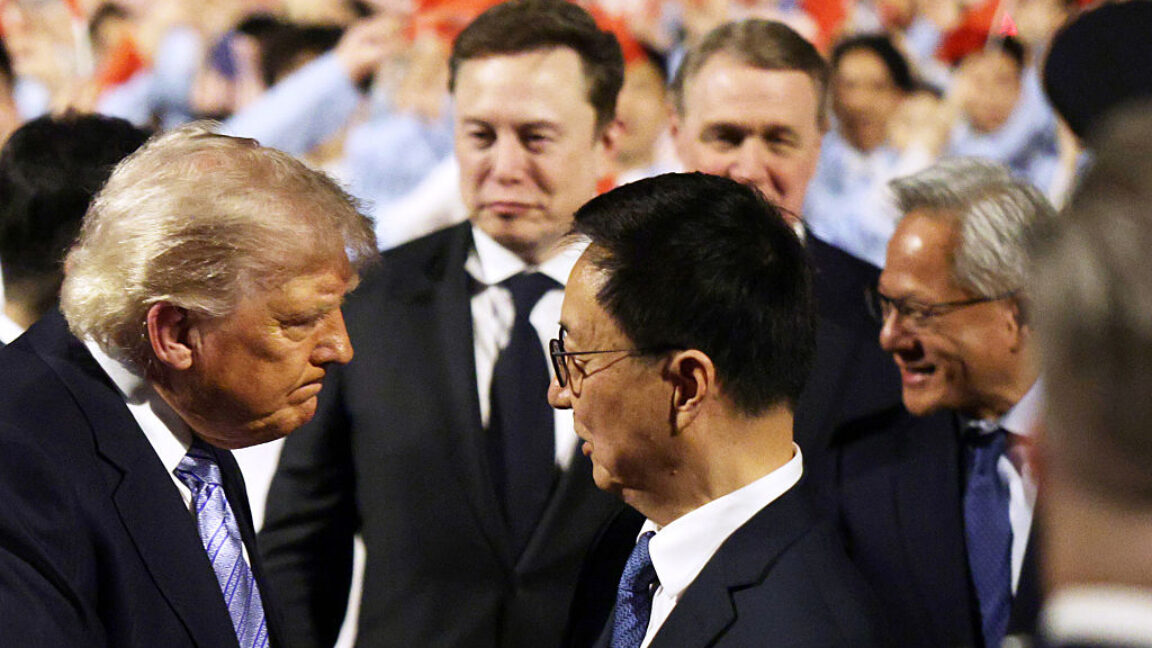
President Donald Trump abruptly canceled an event on Thursday just hours before he was scheduled to sign an executive order granting the government the power to test frontier AI models before their public release.
As The New York Times explained, Trump had been hoping that top executives from leading AI firms would attend the signing. He decided to pull the plug after learning that some CEOs couldn’t make the event. That made Trump unhappy, even though he’d only given them 24 hours’ notice. Other AI executives who quickly rearranged their schedules to go “were midair on their way to the Oval Office” when they found out that the trip was for nothing.
Reporting from Semafor indicated that OpenAI “supported” the signing. However, xAI founder Elon Musk and Meta CEO Mark Zuckerberg reportedly helped “derail” the executive order, supposedly urging Trump to “call it off.” Additionally, Trump’s former AI advisor David Sacks—whose special government employee designation expired in March, The Information noted—joined the push to delay the signing, Semafor reported.
According to Reuters, the tech industry lobbied against the order, fearing that safety testing could delay model launches or require changes that set back model development. Musk has denied having a hand in Trump’s cancellation of the signing event, Reuters noted, writing on X that “this is false” and claiming that he doesn’t “know what was in that EO.”
Trump has taken a hands-off approach to regulating AI since retaking office, but members of his administration got spooked and began recommending safety testing after Anthropic flagged cybersecurity risks with its latest model, Mythos. Their plan was to get Trump to expand the number of firms submitting to voluntary government testing and vetting of frontier models.
Inside sources and AI firms briefed on the executive order told The Information that one tension between the Trump administration and the tech industry is the timeline for government testing. The government sought to evaluate models up to 90 days prior to release, while AI labs pushed for a much shorter timeline of only 14 days.
The EO’s goal, the NYT reported, was “for the government to identify any security vulnerabilities revealed by AI models and to patch problems in its systems to help protect banks, utilities, and other sensitive industries from cyberattacks.”
Officially, Trump told reporters that he decided against signing the order because he “didn’t like certain aspects of it.” He offered no further details but stressed that government safety testing could set the US back in the AI race with China, claiming that “I really thought [the order] could have been a blocker.”
“I think it gets in the way of—you know, we’re leading China, we’re leading everybody, and I don’t want to do anything that’s going to get in the way of that lead,” Trump said.
US lags behind in AI safety race
It’s unclear whether Trump plans to reschedule the event or what changes might be required to ensure he signs it.
Lizzi C. Lee, a fellow at the Asia Society Policy Institute’s Center for China Analysis, told the South China Morning Post that Trump appears to be navigating the same AI safety dilemma as China: how to guard against national security risks without slowing the development of frontier models.
Lee suggested that the impact of Trump’s order depends on how “heavy the review process becomes.” If Trump’s safety testing focuses narrowly on national security, “it probably won’t slow leading US labs much,” Lee said.
According to Lee, parallel to the AI race is “a separate, potentially more important race” to figure out how “who can govern powerful AI without choking off innovation.”
China may be slightly edging ahead of the US in that race.
SCMP’s report claimed that while the US has been hesitant to regulate AI, “China’s regulatory process is accelerating significantly” in recent months. In April, Beijing issued a new regulation requiring domestic AI firms to establish internal “artificial intelligence ethics review committees.” In May, the State Council, China’s cabinet, outlined a legislative work plan for 2026 to “improve AI governance and accelerate comprehensive legislation for the sound development of AI.”
In the US, discord exists not just between political parties but among Trump’s team, The Information reported. The tensions reportedly started after the abrupt end of Sacks’ tenure as AI advisor, creating a “power vacuum” within the White House’s AI leadership structure. Still, Sacks continues to visit the White House weekly, The Information reported.
As Trump reportedly faces pressure from the Commerce Department and the Office of Science and Technology Policy to maintain a light-touch approach to AI regulation, more security-focused agencies, like the Office of the National Cyber Director, think the time for governance is now.
Trump’s next moves on AI safety in the US won’t just be closely watched by officials within his administration concerned about national security risks—which apparently includes Vice President JD Vance, who said on Wednesday that the administration was prioritizing “protecting people’s data” and “people’s privacy” after concerns about Mythos were raised. Apparently, China will also be expecting regular AI safety updates from Trump.
At the recent summit with China’s president, Xi Jinping, Trump agreed “to launch an intergovernmental dialogue on AI” to mutually navigate emerging national security risks as AI technology advances, the Chinese Foreign Ministry confirmed.
Discussion (0)
Sign in to join the discussion. Free account, 30 seconds — email code or GitHub.
Sign in →No comments yet. Sign in and be the first to say something.