An entire industry is being propped up by math that is insane.
Mirrored from Marcus on AI for archival readability. Support the source by reading on the original site.
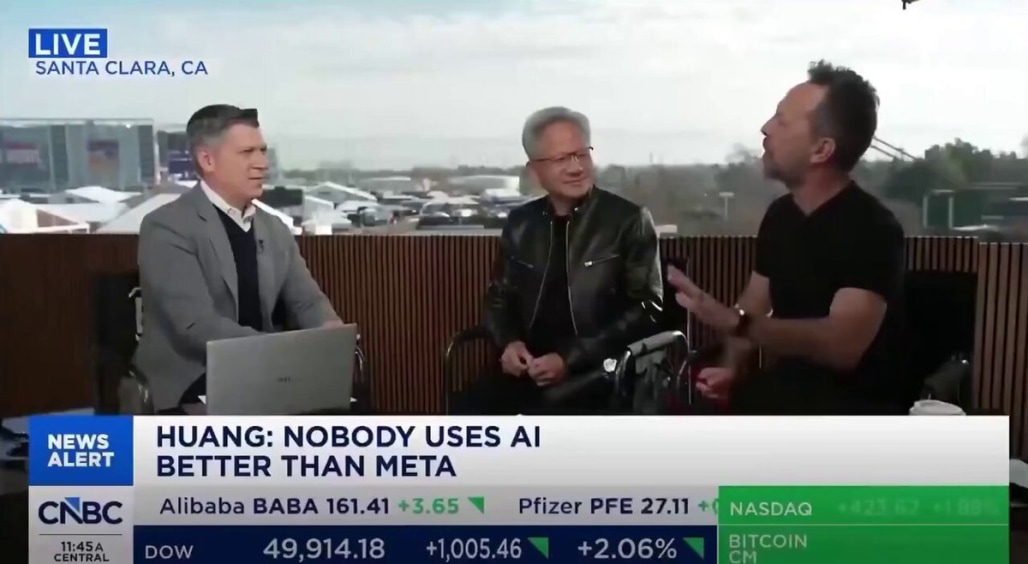
Jensen Huang has apparently likened the upcoming IPO’s to Amazon, Google and Meta:
As someone on X just pointed out (I am rewriting slightly for clarity, and trusting their numbers, which sound about right to me), Amazon returned 2,538x the original investment. If SpaceX were to do the same, its Market Cap would be $4,442 trillion, or 36 times the current total world GDP.
That is absolutely not going to happen.
It’s insane.
§
Another way to think about it.
I have to think that anyone who buys the SpaceX IPO just isn’t that good at math. Or history.
§
At least a few people have figured that out:
§
A new study , from Jessica Wachter (Wharton) and Jonathan Wachter (Point 72), aims to calculate how much productivity needs to grow for the whole thing not to fall apart. (In technical terms they sought to derive “the cumulative increase in productivity required to justify this level of investment, assuming no change in discount rates, and zero economic profits … Were then boom to be smaller than this, the investments would be NPV-negative.”)
I haven’t looked carefully at the math, and the paper’s lead author, Jessica Wachter, added some nuance on the tweet above’s characterization when I asked but they don’t change the overall situation all that much:
The tweet is correct in that 2.7 is the required multiple of productivity. The missing context, however, is that the 2.7 number applies to the AI sector, broadly defined. Also, large companies with relatively low debt have ways of staying out of bankruptcy, so there would be some leeway in how long that increase in productivity would take to play out. That said, we do assume it would occur by 2028 (which is reasonably quickly).
In any case, I share the paper’s observation that what we have now is “a productivity boom that is in investment data, but not yet in productivity data. If the boom fails to materialize, the current buildout will be the largest misallocation of capital in history” (a phrase and conclusion almost identical to one I used here in April).
§
If there is a boost in productivity, we will perhaps see it first in coding, but 2.7x relative to the entire economy is an enormous ask.
§
And that doesn’t even of course count the many other risks to society, many just summarized in this massive review:
§
Yet donations to Jensen’s retirement fund keep pouring in. Data below are from https://isaiprofitable.com, which I strongly encourage to you to visit.:
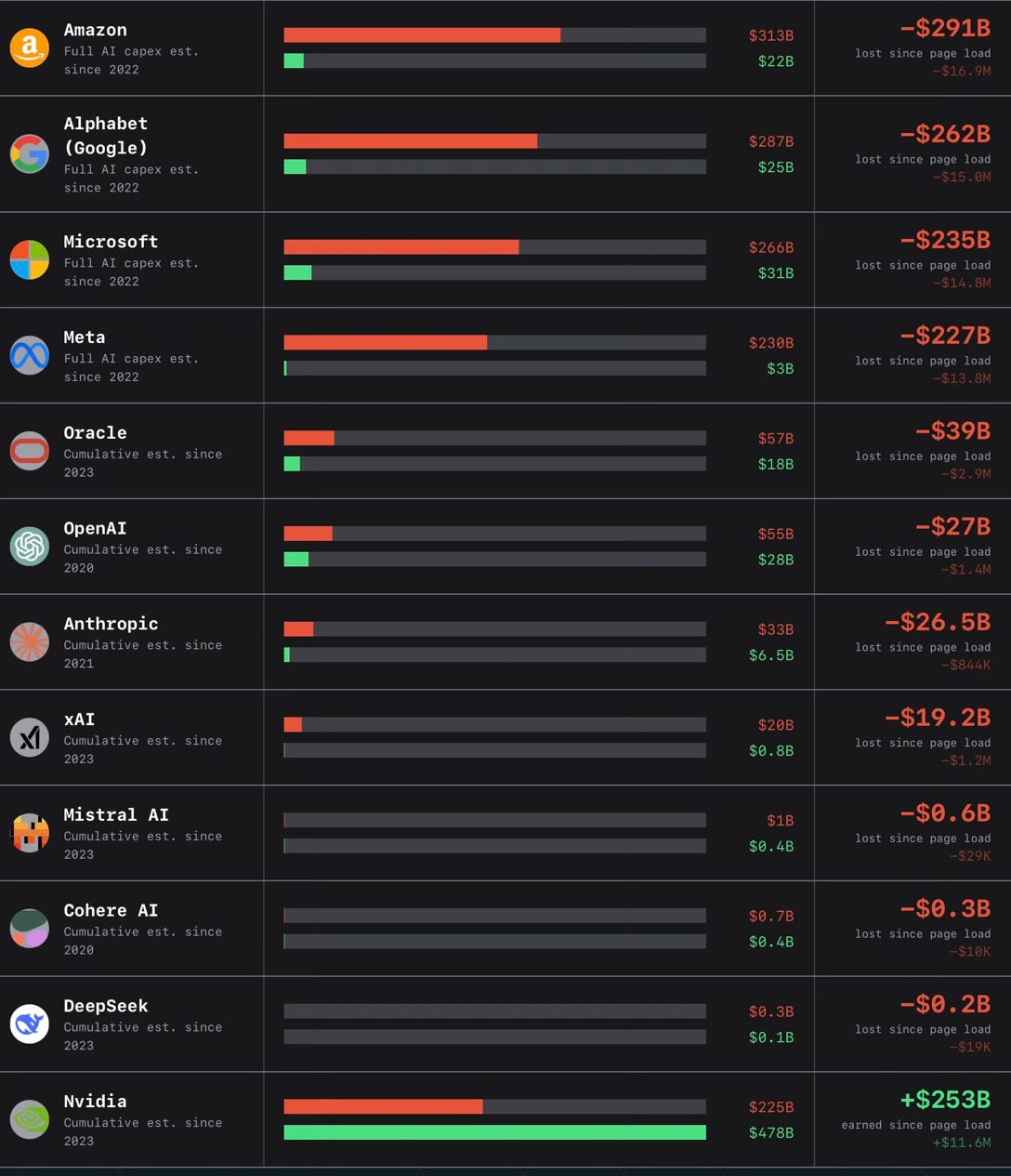
The best part of https://isaiprofitable.com is the dollars “spent since page load” counter, which tells you how much money is wasted while you linger on the page. If you stay for around a minute, you can be witness to burning of million dollars of capital.
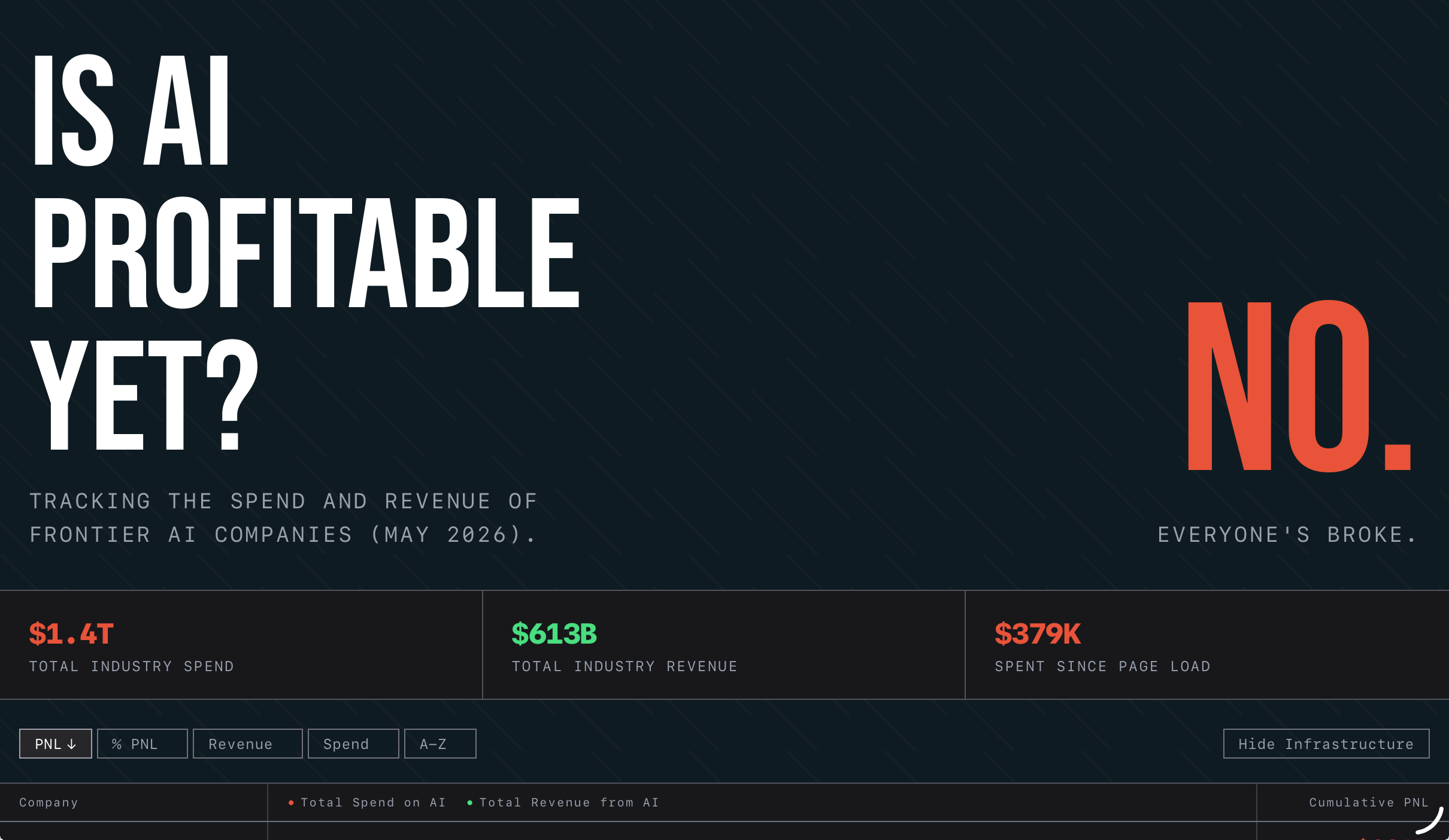
AI is not profitable yet, and may never be. And, breaking news, costs are rapidly rising too:
GenAI is a risky bet that could pay off, or it could well tank the economy. (A more reliable form of AI might be a safer bet.)
Certainly, SpaceX will never return the way Amazon did. OpenAI is in trouble, and may not make it. Anthropic has a chance of being profitable, but reaching 10x the IPO price would be amazing. To get to 100x the expected IPO price of $1 trillion would mean a market cap of nearly the entire world GDP (about $125 trillion), another manifest absurdity; 1000x is out of the question. (Also the whole thing Jensen Huang said is an example of a kind of post hoc fallacy, in which you take the most extreme outliers in history post hoc and project from there. Elon is presumably counting on retail investors to succumb to the same fallacy.)
I do have to wonder whether the guys talking this stuff up believe what they are saying, or whether they are saying it even though they know it can’t be true – or whether they are just bad at math.
Discussion (0)
Sign in to join the discussion. Free account, 30 seconds — email code or GitHub.
Sign in →No comments yet. Sign in and be the first to say something.