Show HN: Bodily Oddities
Mirrored from Hacker News — AI on Front Page for archival readability. Support the source by reading on the original site.
Bodily Oddities
143 Strange things bodies can (sometimes) do.
Results appear below as you type.
Browse by body region
Browse by kind
Recently added
Changelog
Jamais vu
A familiar word, face or place suddenly feels strange, as if you are meeting it for the first time. It is the opposite of déjà vu, and researchers think it is rarer. In lab studies, more than half of people felt a common word turn strange after copying it about 30 times.

Prosopagnosia
People with prosopagnosia, or face blindness, find it hard to recognise faces, even those of family and friends. Most have had it all their lives. It can also start after brain damage. Estimates run from about 1 in 100 people to about 1 in 40, depending on how it is tested.

Aphantasia
Most people see a picture in their mind when they think of a friend's face. People with aphantasia see only a faint image or none. About 4 in 100 people are like this, and about 1 in 100 see nothing at all. A few people have images almost as vivid as real sight.

Camptodactyly
A finger that stays bent forward at its middle joint and cannot fully straighten, usually the little finger. Under 1% of people have it. Mild cases rarely cause trouble, but the bend can get worse while a child grows.

Linburg–Comstock variation
An extra tendon link in the forearm that ties the thumb to the index finger. When the thumb bends into the palm, the index fingertip bends with it. Roughly 1 in 5 people have it, but counts vary widely.
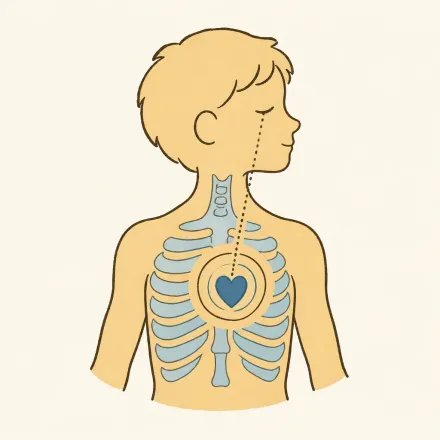
Oculocardiac reflex
Pressure on the eyeball, or a pull on an eye muscle, makes the heart slow down. It matters most during eye surgery, especially in children. It is not a safe way to slow your own heart.
Try one right now
See all
Afterimages
An image that stays in your vision after the thing you looked at is gone. Bright things leave a same-colour copy for a moment. Long stares leave a copy in opposite colours.

Ambidexterity
Using both hands equally well for every task. About 1% of people are truly ambidextrous. Many people who say they are ambidextrous are mixed-handed: right hand for some jobs, left for others.

Attached and free earlobes
Some earlobes hang free and others join the head directly. Textbooks taught this as one gene, but a 2017 study found at least 49 genetic regions involved, and the two shapes blend into each other.

Bifid uvula
The uvula, the dangling flap at the back of the throat, is split into two lobes, in about 1 to 2% of people. On its own it is harmless, but in a baby it can be a clue to a hidden cleft of the palate.

Blue arcs of the retina
Look at a small red light in a dark room and two faint blue arcs curve away from it towards your blind spot. The arcs follow the paths of the nerve fibres in your own retina.

Blue field entoptic phenomenon
Tiny bright dots that dart along wiggly paths when you look at a clear blue sky. They are your own white blood cells moving through the capillaries of the retina.
It felt scary but it is normal
See allThings that alarm people but are harmless.

Accessory ossicles
Small extra bones, most often in the foot, that form when a growth centre never fuses with its main bone. They are usually harmless but can be mistaken for fractures on an X-ray.

Alice in Wonderland syndrome
Objects, body parts, or the whole room suddenly look far too big, far too small, or far away. It mostly happens to children, often during a fever or infection, and it passes on its own. In adults it is usually linked to migraine.

Benign fasciculations
Small visible twitches in the eyelid, calf, thumb, or arm that come and go with no weakness. One survey found them in about 70% of healthy clinicians. They are very rarely a sign of nerve disease.

Brain zaps
A brief feeling like a small electric shock inside the head, often set off by moving the eyes. It is most common when stopping or lowering an antidepressant. It is unpleasant, but usually not a problem.

Call of the void
A sudden, brief thought of jumping when you stand somewhere high, with no wish to do it. About half of people get it. It is probably the brain's safety system being misread, not a hidden wish.

Cervical rib
An extra rib above the normal top rib, growing from the lowest bone in the neck. About 1 in 100 people have one, and most never know.
Discussion (0)
Sign in to join the discussion. Free account, 30 seconds — email code or GitHub.
Sign in →No comments yet. Sign in and be the first to say something.