"We pissed off a lot of people": Giant data center plan cut 50% amid protests
Mirrored from Ars Technica — AI for archival readability. Support the source by reading on the original site.
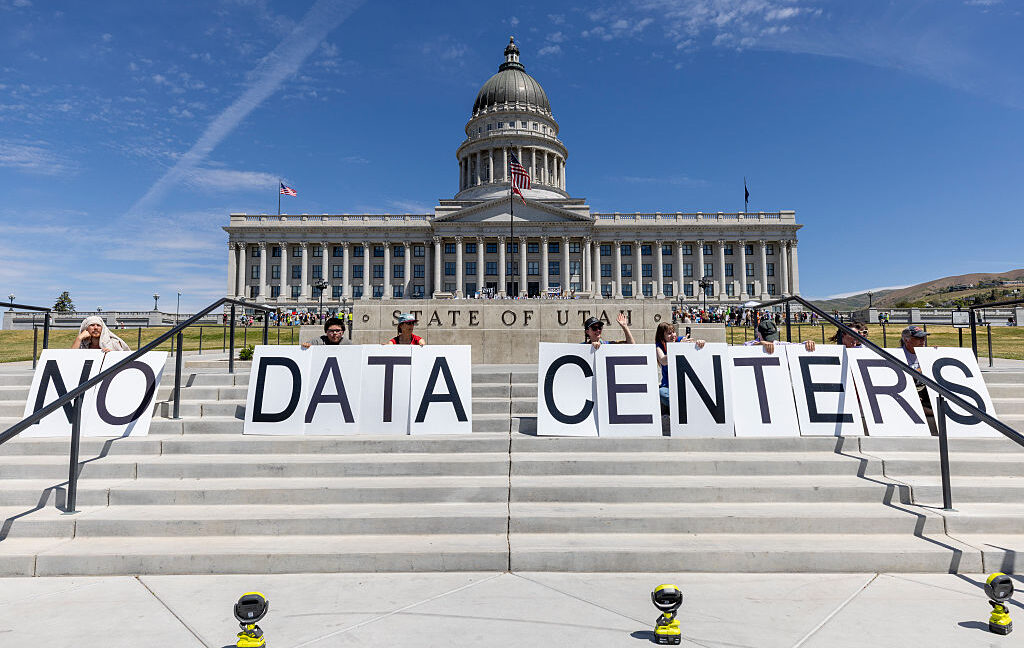
One of the world’s biggest data center projects was designed to be nearly three times the size of Manhattan, stretching across multiple Utah sites. But intense local backlash in Box Elder County has now pushed the developer to cut the project plans in half before construction starts.
Residents’ top concern was the Stratos data center project draining local waters, and they were willing to pay to protect them, most especially the vulnerable Great Salt Lake. Many locals paid a $15 fee to register comments to block the transfer of 1,900 acre-feet of water from a ranch to the hyperscale data center. Other concerns include electricity bills rising and potential risks to air quality, local wildlife, and land.
Venture capitalist Kevin O’Leary, chair of O’Leary Digital and Shark Tank investor, is behind the construction of the project. He told a local ABC affiliate that he regrets not working with state officials to be more transparent about the project from the beginning.
“We really screwed it up,” O’Leary said, while confirming that he “was not expecting this kind of intense blowback from the public.” He claimed that he and state officials anticipated that “people would be excited” about the major local investment and “made huge mistakes” by not involving the public more in discussions, based on that “assumption.”
“We pissed off a lot of people, and that’s not the way I do business,” O’Leary said. “That’s not.”
As Utahns moved to defend their resources and demanded more information, Utah Senate President Stuart Adams, who is a Republican, sent a letter to O’Leary, asking him to cut the project’s scope by 75 percent.
At an AI gala in Washington, DC, O’Leary claimed that he had “no choice” but to agree, NBC News reported. Initially, he planned to build the project on 40,000 acres, but now he’s reduced that to about 20,000 acres. Of the remaining land, 10,000 acres will remain undeveloped, leaving about 25 percent of the initial acreage to develop the data center. O’Leary’s group characterized this as bending to the Senate president’s demands.
Moving forward, O’Leary wants to rebuild trust, he claimed. He told the ABC affiliate that he’s personally taking over all communications on the project because he didn’t “like being beaten up like this.” With him as spokesperson, residents will supposedly be better informed about permitting requests and environmental impacts, rather than relying on sources that O’Leary claimed are unreliable or bent on manipulating public opinion.
“All the plans are going to be transparent,” O’Leary said, while claiming that public concerns are exaggerated. “All the design is going to be transparent. Everything we do is going to be transparent because I’m not happy with where we’re at right now.”
He told the AI gala attendees that he now recognizes that “we should have answered all this stuff up front, now I got to do it after everybody’s been pissed off.”
“I hope this dialogue can serve as a model for how complex projects are best addressed—through direct, good-faith engagement between developers and elected officials rather than through public narratives that outpace the facts,” O’Leary told a local Utah news site KLS.com.
Critic slams plan as “performance art”
Before construction can begin in Utah, O’Leary’s project will need to secure more approvals and complete several environmental reviews, a local nonprofit, Alliance for a Better Utah, noted in a statement on the plan to shrink the data center.
In response to O’Leary’s letter, Adams celebrated the compromise and claimed that the project could become a roadmap for how responsible data center development should work in the US.
“With responsible water use, transparency and input from the people of Utah, we will show the nation how to build it right,” Adams said. “There must be written commitments in place, and the proposal must undergo a full permitting and environmental review process, just like any other development project in Utah.”
But some locals think there is no going back once trust is lost. After the water transfer backlash, the Salt Lake Tribune editorial board warned, “even if the data center isn’t as dreadful as feared—or if it never is actually built—the stench attached to the rushed and secret political process will take a very long time to dissipate, if it ever does.”
Unsurprisingly, some residents who oppose the data center aren’t optimistic that O’Leary’s plans will do much to mitigate the local impacts they fear. NBC’s report noted that it’s not “immediately clear if the overall nine-gigawatt capacity of the project will change.”
Brenna Williams, a community member involved in the Box Elder Accountability Referendum opposing the project, called the agreement “excellent performance art,” KLS.com reported.
“I think this was the plan all along,” Williams said, suggesting that the project never would’ve been approved if the public had been engaged at the start of discussions, because the area is simply not a good candidate for a data center due to water constraints.
“I don’t see any changes, and the truth is, Box Elder County is just too vulnerable for a hyper-scale data center of this size,” she said. “No matter what he does given the situation, there is going to be a big impact.”
Data center backlash influencing elections
Adams’ pivot toward transparency is supposedly linked to his reelection bid. He’s facing down a primary against two Republican challengers this June, the Hill noted, and O’Leary told NBC News that he thinks Adams was pressured to challenge the data center size to keep his campaign on track.
“I know he did it for political reasons,” O’Leary said.
While Donald Trump has advocated for rapid data center development across the US to keep America ahead in the AI race, the Utah case shows that not every Republican can afford to be an AI booster. A recent HeatMap poll showed “a rapid shift in public opinion since last fall,” with at least 7 in 10 Americans now opposing data centers built near their homes.
With “an absolute majority” now opposing data centers, Democrats could seize opportunities to unseat Republicans who fall in line with Trump’s agenda, simply by demanding more transparency.
Perhaps the best example of this is Illinois governor J.B. Pritzker. On Friday, NBC News reported that Pritzker plans to temporarily halt all tax breaks to data centers in his state until a legal framework can be drafted to ensure responsible development. Pritzker “is widely viewed as having 2028 White House aspirations” and may soon show he’s up to the task if he succeeds in taking control over regulating frontier AI away from Trump.
Eliminating tax breaks might push projects onto more suitable sites, critics think. In Utah, Williams suspects that tax breaks are the biggest reason why O’Leary wants to develop his project there, the ABC affiliate reported.
“There are places who really want this project, she said. “For him to be fighting so hard to put it here, seems kind of ridiculous because there are places who really want it. I’m not so sure he’d get the same tax concessions as he got in Utah, but he could try. And they would open their arms to him and be grateful for the opportunity. In Box Elder, we don’t want it.”
Debate over what is stoking data center backlash
Many locals protesting data centers don’t stop until the projects are shut down. Last month, HeatMap Pro released data showing that “at least 20 data center projects were canceled after facing significant public backlash in the first quarter of this year.”
“That is more than double the number that were canceled the previous quarter,” HeatMap reported, while noting that data centers are “slightly more unpopular” with rural voters who typically trend more conservative.
Environmental activist Erin Brockovich recently launched another resource, which tracks where data centers are pending, approved, under construction, and operational. Thousands have already contributed to her map tracking data center fights throughout the US.
Although reports indicate—and Adams said was the case in Utah—that communities have genuine concerns fueling the rise in opposition, not everyone agrees that the immense community backlash in the US is rational or proportionate.
On Bluesky, Will Stancil, a lawyer, activist, and housing policy researcher, commented on HeatMap’s poll, suggesting it seemed unusual for public opinion to shift so quickly without “some major data center disaster.” In his thread, Stancil boosted a reply suggesting that data center backlash “hit the algo,” raising a theory that social media is possibly driving anti-data center sentiment.
And while O’Leary blamed himself and Adams for making “mistakes” in Utah, he also claimed that the protests he faced in the state were due to foreign interference, NBC News reported. He accused China of supposedly funding the Alliance for a Better Utah to conduct a smear campaign to set back his project, a claim which the nonprofit has denied.
“All these people have a right to get information,” O’Leary said. “Why are they getting it from a false initiative? Who is spending all this money to put out all these falsehoods and straight-out misinformation and lies and agitate these people?”
In a statement, Elizabeth Hutchings, the communications manager for the Alliance for a Better Utah, mocked the Montreal-born O’Leary, defending the group’s 15-year history and saying, “the only foreign interest in this data center is Kevin from Canada.”
“It’s insulting to Utahns across the state to say that any opposition or protest to this data center is the work of a foreign government,” Hutchings said. “We are proud to live in a state where there are people who deeply care about transparency, their community and their kids’ futures. It is not strange to us that Utahns want to feel heard in decisions that will impact their lives for decades to come.”
Hutchings agreed with Williams that “the issues with the deeply unpopular and problematic project in Box Elder County remain.”
“This is not the first time we’ve dealt with bullies like Kevin trying to intimidate us into silence,” Hutching said. “No amount of propaganda and dramatic distractions will stop us from talking about the real issue: a lack of transparency from our government.”

Discussion (0)
Sign in to join the discussion. Free account, 30 seconds — email code or GitHub.
Sign in →No comments yet. Sign in and be the first to say something.