AI content creation tools like Google’s new Omni model threaten to make reality even harder to discern from AI fantasy, but YouTube is taking an important step toward verifying video origins. After debuting wishy-washy AI content labeling in 2024, Google will begin using more prominent labeling for AI videos, and the site will no longer rely entirely on uploaders to divulge when they use AI tools to create a video.
When YouTube first attempted to tackle the identification of AI videos in 2024, it was almost gratuitous. AI videos at the time nearly always outed themselves by looking bizarre or disjointed. In just a few years, AI models like Seedance, Runway, and Google’s own Veo have raised the bar for realism and consistency in AI video—the spaghetti is more accurate than ever.
Recognizing that, YouTube is making the AI labels more prominent and automating part of the process. Creators are still required to indicate when uploading videos if they were created with the help of AI tools. However, uploaders didn’t have any incentive to be honest about that before. Starting this month, YouTube will use “new internal signals” to flag AI content. This will apparently apply to videos that show “significant photorealistic AI use.”
Simplified AI Labels & Auto-Detection: What You Need to Know
Google is vague about what signals will figure into its AI detection system—we’ve asked for more details and will update if we hear anything. The blog post does mention two ironclad triggers: C2PA metadata indicating a purely AI source and the use of watermarked Google tools like Veo. Creators who believe their videos have been tagged as AI incorrectly can appeal, but not if the site marks an upload as AI for either of those reasons. Those labels are “permanent.”
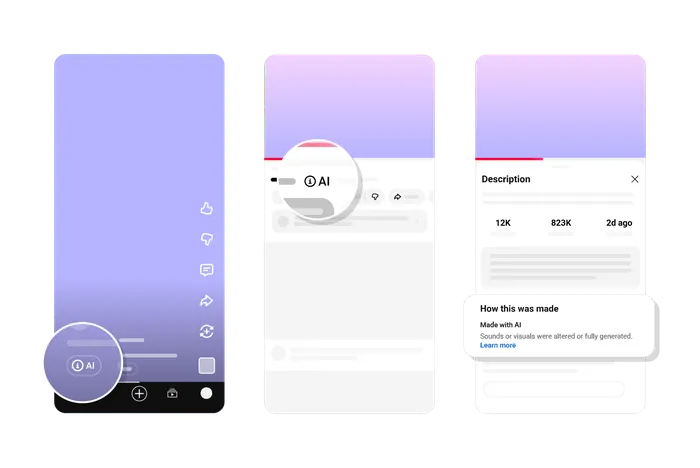
When applied, the new labels will also be in a place where you’ll actually be able to see them. Previously, Google’s essentially voluntary AI labels were only visible in the expanded video description in a section titled “How this content was made.” If you didn’t go looking for that information, you would never see the label at all.
The three styles of AI labels you will now see on YouTube.
Credit:
YouTube
The three styles of AI labels you will now see on YouTube.
Credit:
YouTube
As the new system rolls out, Google will use labels that are more prominent on both standard videos and YouTube Shorts. For videos filmed the right way (landscape), the AI tag will appear directly below the video and above the description box. For Shorts, the label will appear as a small overlay at the bottom of the video itself, although that will add to the already cluttered look of the TikTok-aping Shorts.
YouTube says the new label is intended to be clear and easy to glance at. It’s a small ellipse with “AI” and an information symbol. The company has not specified if the label is clickable, but it certainly looks that way. Importantly, there may still be AI content on YouTube that doesn’t use the new label. Google says this system is aimed at “photorealistic and meaningfully AI altered or generated content.” An animated video created with AI or a realistic one that only has a few AI elements will continue to have AI disclosures in the expanded description box.
Ryan Whitwam is a senior technology reporter at Ars Technica, covering the ways Google, AI, and mobile technology continue to change the world. Over his 20-year career, he's written for Android Police, ExtremeTech, Wirecutter, NY Times, and more. He has reviewed more phones than most people will ever own. You can follow him on Bluesky, where you will see photos of his dozens of mechanical keyboards.

Discussion (0)
Sign in to join the discussion. Free account, 30 seconds — email code or GitHub.
Sign in →No comments yet. Sign in and be the first to say something.