Inside Meta's attempts to play catch-up with AI
Mirrored from Ars Technica — AI for archival readability. Support the source by reading on the original site.
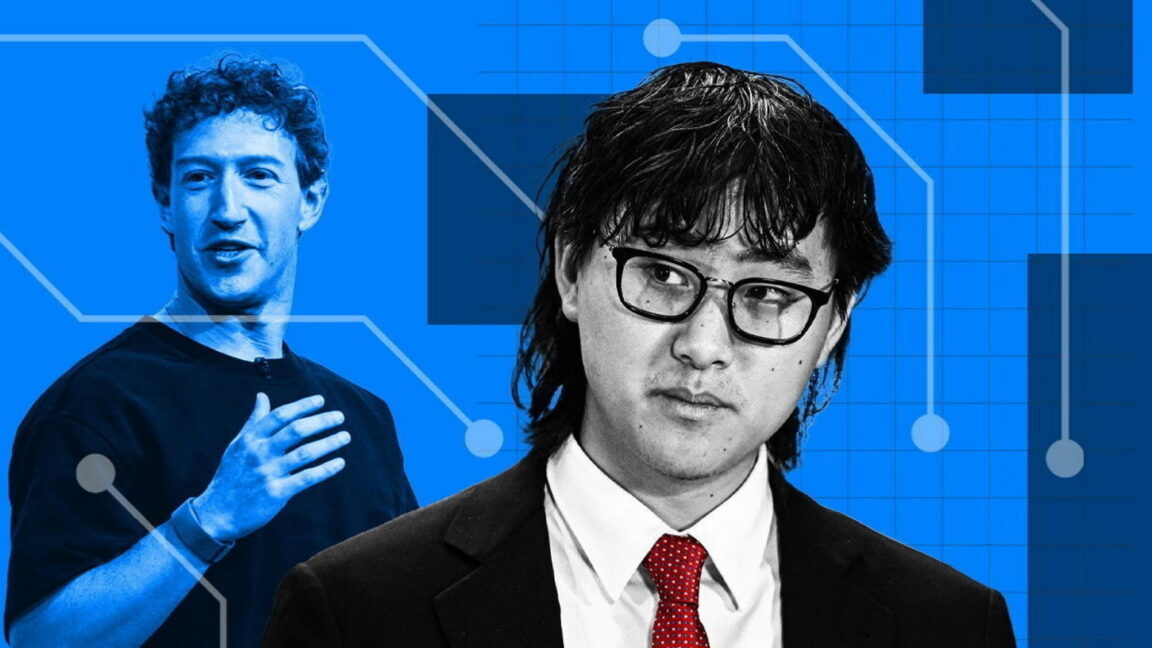
A year after Mark Zuckerberg installed Alexandr Wang to jolt Meta’s artificial intelligence efforts into wartime mode, the $1.5 trillion company has produced Muse Spark, its most credible AI model yet.
By handing responsibility for Meta’s AI revival to a then-28-year-old start-up founder rather than a veteran researcher, Zuckerberg bet that an outsider’s urgency and ambition could succeed where the company’s established AI organisation had struggled.
According to interviews with current and former Meta employees, and associates of Wang, the billionaire wunderkind has now begun to eke out results, while navigating criticism over his experience, early research challenges and the esoteric internal politics of working at a Big Tech behemoth.
In nearly 12 months, Wang has assembled an elite research group on multimillion-dollar salaries, reshaped parts of Meta’s AI operation and emerged as one of the most influential executives inside the company—the only Meta leader alongside Zuckerberg to attend a White House dinner with top Silicon Valley figures last year hosted by President Donald Trump.
In April, Meta also released Muse Spark, the first major model to emerge from Wang’s secretive research group, known as TBD Lab.
Wang’s proponents view the release of the model as the clearest sign yet that Meta’s AI rebuilding effort is gaining traction and are confident that successor models—expected to launch in the coming months—could further close the gap with OpenAI, Google and Anthropic.
“The amount of work the TBD Lab was able to do in a short amount of time is very impressive,” said Russ Salakhutdinov, a computer science professor at Carnegie Mellon University and Meta’s former vice-president of AI research. “Alex knows what he doesn’t know and he’s willing to listen.”
Others inside Meta are far less convinced. Critics describe Wang’s leadership as frenetic, arguing he has overplayed what is more incremental progress. Some current and former employees are sceptical that Meta can gain a leading position in frontier AI under Wang.
“The TBD folks, Alex and Zuck too, set a pretty low bar for Muse Spark internally and externally,” said one former Meta AI employee. “The other labs are moving fast.”
Meta said: “Alex’s record speaks for itself: In less than a year, he’s helped build one of the strongest research teams in the industry and led Meta Superintelligence Labs as it launched Muse Spark and established the scientific and technical foundations to scale even more advanced models. We’re excited for everyone to see what they do next.”
Meta is spending tens of billions of dollars on AI, with investors demanding evidence the outlays will translate into revenue. Muse Spark, and future TBD models, are expected to improve Meta’s content and advertising targeting machines, and also underpin initiatives ranging from AI assistants and business agents to digital avatars and wearables.
Wang was recruited after Meta’s AI efforts suffered a series of setbacks last year, culminating in the disappointing reception to the Llama 4 model and growing concern inside the company that rivals were pulling further ahead.
Zuckerberg responded by investing $15 billion into Wang’s data-labelling start-up Scale AI and hired its co-founder.
Scale AI had worked closely with leading AI labs, with Zuckerberg believing that Wang’s network and operational intensity could help rebuild Meta’s research organisation.
Granted unusual autonomy and secrecy, Wang quickly assembled TBD Lab, a handpicked group of about 100 researchers working from a secure area of Meta’s Menlo Park headquarters that requires special badges to enter, according to people familiar with the operation.
Both Wang and Zuckerberg have offices inside the work area, while non-TBD staff have occasionally been caught trying to sneak in.
Early on, TBD encountered some teething problems, according to multiple people familiar with the matter. Some staff were poached by rivals, including Ruoming Pang, a former Apple executive, who left after just seven months to OpenAI.
Certain research efforts, including initiatives to develop an entirely new codebase for training models, have faced challenges, several people said.
In the end, Muse Spark was built using some elements of Meta’s pre-existing AI infrastructure, including code and datasets associated with Llama 4, according to people familiar with the project.
Subsequent comments by Wang suggesting Muse Spark had been developed “from scratch” irritated some who felt the contributions of the Llama team were not acknowledged, in a sign of deepening tensions between the company’s established AI teams and the TBD lab.
With the TBD team in place, Wang has sought to establish a roadmap that combines his and Zuckerberg’s vision for “personal superintelligence” with the convictions of individual researchers and the practical realities of scaling the infrastructure needed to train future generations of models, according to people familiar with his thinking.
He has also reshaped Meta’s AI safety work with a new team known internally as TBA, or “To Be Aligned.”
In leadership discussions with executives including Zuckerberg, Wang has prioritised advancing the models while some other leaders have been more concerned with quickly rolling out AI products, according to people familiar with the conversations.
During internal presentations to the AI team known as “Vibe Checks,” Wang espouses an idealistic push towards developing AI so smart that it might solve the world’s problems, at odds with the focus of others on social media applications, one insider said.
Several people said Wang had also advocated placing greater emphasis on proprietary models over Meta’s longstanding open-source approach.
Wang has tried to build support for his vision by cultivating a non-hierarchical start-up culture inside TBD. On a recent podcast, he argued that “the very small team where everyone is ‘cracked’ is always going to move faster than the large org where responsibility is distributed,” using gamer slang to describe highly talented engineers.
He also hosts regular boba tea-fuelled happy hours to foster camaraderie inside the secretive group, according to insiders.
Meta’s broader workforce has experienced a less convivial period. Wang’s first year has coincided with restructurings and rounds of lay-offs across the company, seeking to offset the cost of its AI spending spree.
Some employees have also protested company plans to install tracking software that would capture their computer usage in order to train AI models. Meta on Tuesday told staff in a memo, seen by the FT, that it would roll back parts of the plan following the backlash.
Muse Spark has also been deployed primarily inside Meta’s own products, making it difficult for outsiders to assess. Wang had indicated that some external companies would receive access through a private API, but that rollout has been limited.
The model was trained using some third-party open-source models, including Chinese ones. Some insiders have compared aspects of the system with DeepSeek’s latest model, although the extent of any similarities remains disputed.
Muse Spark has been praised for visual understanding, but Wang has acknowledged it trails rivals in coding. Several employees said staff asked to test the model for software development tasks continued to prefer Anthropic’s Claude.
Future Meta models are expected to focus on coding, completing agentic tasks and more advanced multimodal capabilities, including video generation.
“It was a rough start for him to find his power at the company,” said one associate. “But he’s found his groove.”
© 2026 The Financial Times Ltd. All rights reserved. Not to be redistributed, copied, or modified in any way.
Discussion (0)
Sign in to join the discussion. Free account, 30 seconds — email code or GitHub.
Sign in →No comments yet. Sign in and be the first to say something.