California AB 2047 makes 3D printers off-limits to students, educators, business
Mirrored from Hacker News — AI on Front Page for archival readability. Support the source by reading on the original site.
The bill cleared the full Assembly and has moved to the State Senate, where it goes first to the Judiciary and Public Safety committees. These members decide whether AB2047 advances - so these are exactly the people who need to hear from you now. Below is every member of both committees, with a direct phone line and email for each.
Email every committee member
One email can reach every committee office plus the legislative staff who handle these bills. Copy the full list, paste it into the BCC field so offices don't see each other's addresses, and send a single message.
Suggested subject: Please vote NO on AB 2047. Tip: paste into BCC, not To.
Better yet, call their offices
A ringing phone in a Capitol office is hard to ignore - calls often carry more weight than email. No script needed: give your name, say you're a Californian, and urge a NO vote on AB 2047. Tap any number to call that office directly.
Scroll for the full list. Anna Caballero and Scott Wiener sit on both committees, so the email list above counts each of them once.
Write in your own words - here are the points that matter
Personal letters from real Californians carry far more weight than form letters. Pick the points that matter to you and tell them why, in your voice:
- The bill does not make anyone safer.
- The bill was rushed and now contradicts itself - after 33 amendments, its manufacturer mandate points to certification rules the same amendment deleted.
- The required technology is not possible - 3D printers read code, not intent; they cannot tell what a shape is for.
- The bill requires software that, if it could exist, would violate the First Amendment.
- It disrupts education at every level - K-12, CTE, libraries, community colleges, and universities.
- It breaks open-source 3D printing, which most classroom printers rely on, by demanding open firmware be as locked-down as proprietary firmware.
- California small businesses bear the burden - they must source or build firearm-blocking software that does not exist just to keep selling printers.
- The penalties hit the wrong people - the $25,000-per-violation fines fall on schools, makers, and small businesses, while bad actors route around the law.
- The exemptions are undefined - the bill exempts printers sold "exclusively" to entertainment studios, but no printer is built for one industry, leaving makers and cosplayers out.
Things you can do today.
Legislators weigh messages from the people they represent most of all - so if you live in California, your own Senator and Assembly Member need to hear from you. But every informed voice adds to the pressure, in California and beyond. Each of these takes five minutes or less. Do one today. Do all three this week.
Contact your representative
Find your own State Senator and Assembly Member, and tell them to oppose AB2047. Representatives listen hardest to the constituents they answer to - and the more informed Californians who speak up, the louder that message lands. Phone calls beat emails. Two minutes, big impact.
Sign the petition
Add your name on Change.org - Stop AB 2047: Protect Access to 3D Printers in California.
Share with one person
A parent, teacher, or fellow maker. That's how this grows.
What AB2047 actually does.
The bill sets up a new state regulatory regime for 3D printers, rolling out over six steps between today and 2029. Here's each one, in plain language.
California DOJ studies "blueprint detection"
The Department of Justice is directed to investigate firearm blueprint files and existing detection algorithms, and publish performance standards.
DOJ begins certifying algorithms
Third-party vendors can submit their detection algorithms for state certification, and DOJ publishes guidance on "firearm blocking technology" to be installed on printers.
Manufacturers must submit attestations
Every company making or selling 3D printers in California must submit an attestation per make and model, confirming certified blocking tech is installed.
DOJ publishes the "approved list"
The state maintains a public list - updated quarterly - of 3D printer makes and models that have submitted valid attestations. If it's not on the list, it can't be sold here.
The sale ban takes effect
Sale or transfer of any 3D printer not equipped with certified blocking tech and not on the approved list is prohibited. Civil lawsuits may be filed against violators.
New criminal penalties
It becomes a crime to disable, uninstall, or circumvent the firearm blocking tech on a 3D printer with intent to manufacture firearms.
What Californians stand to lose.
3D printing is one of the most widely-adopted hands-on learning tools in California schools. AB2047 puts that infrastructure - and the businesses built around it - in the crosshairs.
The people who use 3D printers every day.
AB2047 targets the hardware, but the impact lands on students, teachers, makers, and small business owners using these tools for entirely legal, productive purposes.
Students & educators
Over 1.5M California students access 3D printing through school maker labs, CTE programs, and college engineering courses. Most school printers wouldn't qualify under AB2047's attestation regime.
K-12 · CTE · Higher EdMakers & small business
Prototype shops, dental labs, custom manufacturers, jewelers, medical device startups - every California small operation that depends on affordable, general-purpose printers.
30,000+ businessesOpen-source & hobbyists
RepRap, Voron, Klipper, and countless community-built printer designs cannot participate in a manufacturer-attestation system. They'd simply not be sold in California.
Community hardwareResearchers & engineers
Labs that modify firmware, experiment with extruders, or build next-gen additive manufacturing depend on hardware they can legally configure. Criminalizing circumvention chills real research.
Research & R&DLibraries & community spaces
Hundreds of California public libraries and community maker spaces offer free 3D printer access. Replacement on compliance grounds would gut those programs - disproportionately in low-income areas.
Public accessTaxpayers
AB2047 creates a new DOJ certification regime, a quarterly-maintained list, and a civil enforcement mechanism - all paid for with California tax dollars, to solve a problem federal law already addresses.
State-mandated programWhat the bill can't solve.
AB2047 rests on two foundations that cannot bear its weight: the legal foundation conflicts with established First Amendment law, and the technical foundation assumes capabilities that do not reliably exist.
Prior restraint on protected speech
CAD files and source code are protected expression; mandatory pre-review is a textbook prior restraint.
Compelled speech
Forcing manufacturers to attest to contested algorithm output is compelled speech on a public concern.
Vagueness in "blueprint"
Shapes shared between firearm parts and countless legitimate objects give no clear notice of prohibited conduct.
Overbreadth
The bill sweeps in general-purpose hardware used overwhelmingly for lawful purposes.
Commerce Clause concerns
A state-specific approved list for interstate hardware raises serious Dormant Commerce Clause issues.
Federal preemption
Federal law already covers firearm manufacture, including via additive manufacturing.
Six more concerns detailed
Delegation, due process, Fourth Amendment telemetry, and state constitutional issues.
Geometry isn't uniquely a firearm
A rifled barrel is a grooved cylinder. So are industrial screws, optical mounts, and thousands of other parts.
Trivial workarounds
Rotation, scaling, splitting a model into parts, or re-exporting defeats shape-based detection - without losing function.
G-code is the wrong layer
By the time a printer sees G-code, shape context is gone. Reconstructing a "firearm" at print time is intractable.
Firmware is open
Marlin, Klipper, and RepRap firmware can be flashed in minutes. Software-level "blocks" are simply removable.
No ground-truth dataset
There is no authoritative dataset of "firearm blueprints" - and the set grows adversarially.
Published error rates are too high
Research on shape-based detection consistently shows error rates incompatible with general-purpose use.
Six more technical barriers
Remote-print workflows, procedural generation, encrypted slicer output, multi-material composites, and more.
Where it stands right now.
AB2047 cleared the Assembly's Public Safety, Judiciary, and Appropriations committees, survived the Suspense File, and has now passed the full Assembly floor with 33 amendments. It moves next to the State Senate, where it heads first to the Judiciary and Public Safety committees - the stage where your voice matters most right now. Take action now →
Bill Introduced Completed
AB2047 is introduced in the California State Assembly, framed as a public safety measure targeting 3D-printed firearms.
Passed Public Safety Committee Completed
The bill cleared the Assembly Public Safety Committee and was advanced for further review.
Passed Judiciary Committee Completed
The bill cleared the Assembly Judiciary Committee and was advanced to Appropriations.
Appropriations & Suspense File Completed
The bill cleared the Assembly Appropriations Committee, was placed in the Suspense File, and has now been released with 33 amendments and sent to the floor.
Passed the Assembly Floor Completed
The full Assembly voted to pass the amended bill, sending it across to the State Senate for the second half of the process.
Senate Judiciary & Public Safety Active now
The bill now goes to the Senate's Judiciary and Public Safety committees. These members decide whether it advances - so they are exactly who needs to hear from you today. Email the Senate →
Senate Floor Vote Upcoming
If it clears committee, the full Senate votes on the bill.
Governor's Desk Upcoming
The Governor's signature or veto. The bill can be stopped at any stage.
Resources to share and use.
Print-ready handouts, letter templates, and talking points - built for schools, families, and neighborhood meetings.
Parent & teacher one-pager
A single-page handout explaining AB2047 in plain language - ready to bring to your next school board or PTA meeting.
Legislator letter template
An editable letter opposing AB2047. Personalize one paragraph and send in under five minutes.
School board talking points
Bullet-point arguments tailored for school boards and district administrators concerned about CTE impact.
Full bill analysis
Section-by-section breakdown with annotations from lawyers, engineers, and policy experts.
Social media kit
Friendly graphics sized for X, Instagram, LinkedIn, and TikTok - includes parent-focused copy options.
Small business impact guide
Talking points for dental labs, jewelry makers, prototype shops, and other small businesses.
Watch the full breakdown.
Joel Telling (3D Printing Nerd) walks through AB2047, what it means for the maker community, and why the technical premise doesn't hold up.

The story is spreading.
Coverage of AB2047 and the maker community's response from across the tech press.
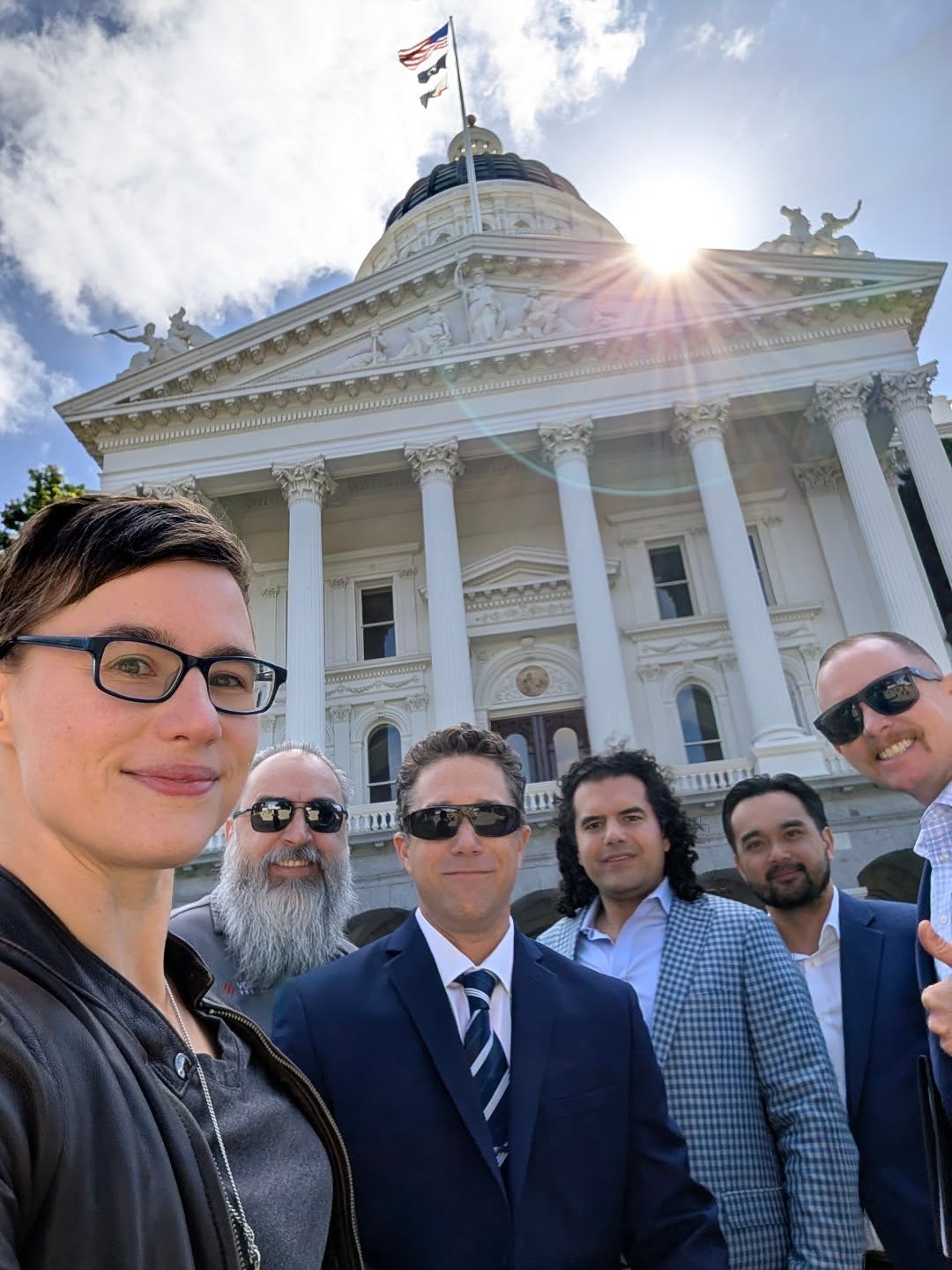
Why California's 3D Printer Bill Worries the Industry: David Tobin Says "It Regulates a Tool, Not the Crime"
"You're regulating a tool instead of the crime. The bigger concern is the precedent." David Tobin argues AB2047 misses the mark by mandating firearm-blocking tech in printers rather than enforcing existing law.
By Vanesa Listek → Read on 3DPrint.com
David Tobin Is Fighting California's 3D Printer "Ghost Gun" Bill
"California's AB2047 is one of the most troubling pieces of 3D printing legislation ever proposed." A profile of David Tobin's push to defeat the bill before the Assembly floor vote.
→ Read on Fabbaloo
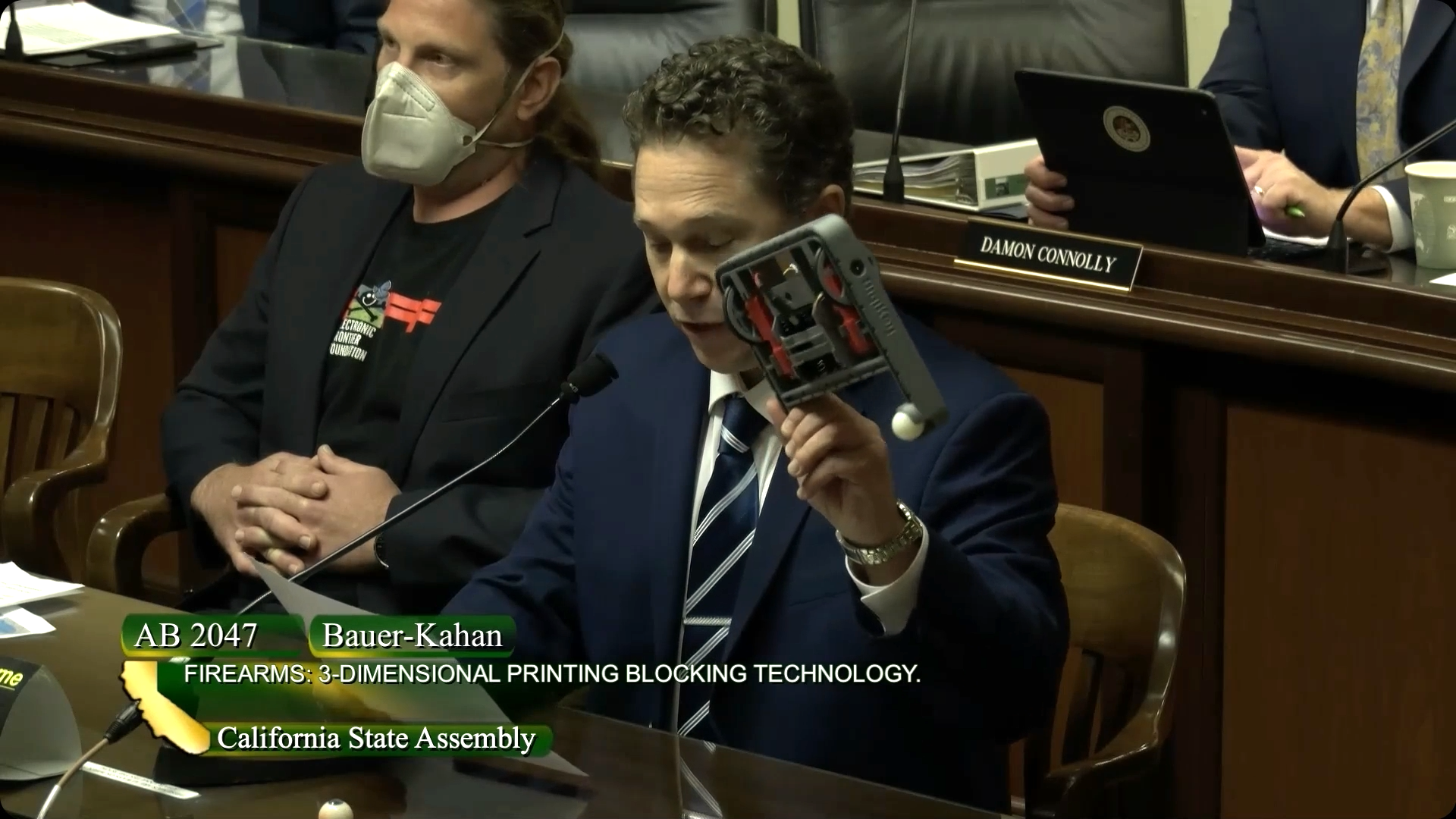
3D printing community organizes against California law that would restrict sales to state-approved models
Experts warn that “safety algorithms” are a death sentence for makerspaces, schools, and innovation - with $10.5B in sunk costs and 1.5M California children using 3D printing today.
By Denise Bertacchi → Read on Tom's Hardware
Discussion (0)
Sign in to join the discussion. Free account, 30 seconds — email code or GitHub.
Sign in →No comments yet. Sign in and be the first to say something.