I Found Ultra-Pure Quantum Crystals in an Abandoned Mine in the Atacama Desert
Mirrored from Hacker News — AI on Front Page for archival readability. Support the source by reading on the original site.
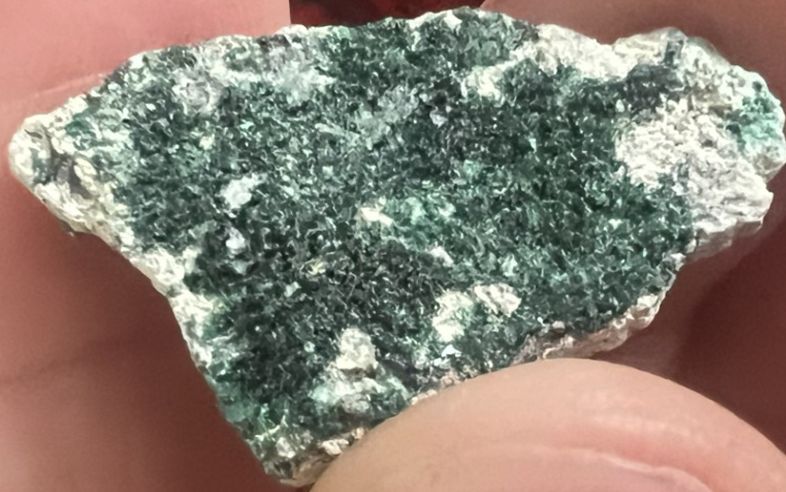
Ultra-Pure Quantum Crystals from an Abandoned Mine in the Atacama Desert
A Two Part Post on the Immense Promise and Ecological Tragedy of Natural Herbertsmithite Crystals
Introduction
Hello Everyone, My name is Dr. Aaron Breidenbach. For those who haven’t been following my journey, I grew crystals of Zn-Barlowite and Herbertsmithite in my PhD at Stanford. These crystals are candidates to be a new novel state of matter called a “quantum spin liquid” (QSL). I just published a paper in nature physics (free version here) with Young Lee’s Lab, providing the strongest evidence to date for the presence of this mythical magnetic state in these crystals. Due to these properties, Zn-Barlowite and its sister QSL candidate material Herbertsmithite have immense potential to be used in future large scale quantum computers. Given what LLMs are currently doing on silicon, one can only imagine how society-altering these crystals might be one day if we can actually fashion them productively in a quantum computer.
What’s more amazing to me about these crystals is that they grow in nature as well. I will emphasize that this is an absolute anomaly. To the best of my knowledge, this is the only crystal with any bulk quantum properties that grows in nature (other than its sister materials like Atacamite). Quantum physics is hard, and me and all of my colleagues in condensed matter physics spend hours intentionally mixing very specific ratios of strange elements to make synthetic quantum crystals like superconductors. This is the norm. And yet, somehow, these crystals, among the most mysterious of them all, just grow naturally, and they have probably been sitting around in the earth’s crust for millions of years or more, long before the dawn of apes as a species.
With this mystical mystery as motivation, I recently set off on an adventure to the Atacama Desert in Chile to find these crystals in their natural habitat. What I found astounded me for many reasons. This is a two part post. In the first post here, I will focus on the immense potential that natural crystals have for advancing our knowledge of quantum physics. Then, in the second post, I will focus on how these crystals are tragically being destroyed in large scale ecologically damaging mining practices in the Atacama Desert.
(For other content related to this project, including interviews, videos, and published papers, please see my website, thequantumarcheologist.org)
The Discovery and the Promise
In my journey to Chile I was successful in finding the legendary natural Herbertsmithite crystals. I made this discovery in collaboration with Anthropologist Vicente Carrasola Vega from the University of Chile. He is the one that spotted the crystals in the field, and he proved to be an indispensable guide, translator, and knowledge holder in the desert. Amazingly, we found these crystals in the waste tailings of the abandoned San Francisco mine. We then verified the identity of these crystals with x-ray scattering with the help of Professor Joseline Tapia and staff in the geology department at the Universidad Católica del Norte in Antofagasta Chile.
This was no small discovery either. We found a lot of these crystals. I have yet to separate and measure all of these crystals, but I’m conservatively estimating by eye that we have at least 10 grams of hexagonal green crystals (but probably much more). I’m hoping most of this is Herbertsmithite, and we also have at least a few grams of the related minerals Atacamite and Zn-Paratacamite. (The x-ray scattering suggests these crystals are mostly Herbertsmithite, ~65% by composition, but this is unreliable and limited to one sample. Future measurements will be more accurate in pinning down an exact ratio and amount).
For comparison, the lab grown crystals are very difficult to grow. It takes about a full work week of preparation and 9 full months of waiting for them to grow to full size. This process also involves a lot of training to master. It is additionally very expensive in terms of equipment overhead (>$10,000) and the reactant chemicals required (~$100 per growth attempt). This synthetic process only produces about 1–2 grams of crystals per test tube and is only successful about 45% of the time. It seems that Vicente and I found nearly 10 times this amount in this single discovery. Meanwhile, the only equipment overhead was a pair of humble $15 pickaxes we picked up at the local mining outlet in Calama.
This is reason enough to study the natural crystals. However, I also found something that is truly spectacular in my geological studies. Natural crystals of Herbertsmithite have been measured to be more pure than our laboratory synthetics. This measurement was done via electron microprobe microscopy by the late Michael Scott in the geology department at the University of Arizona. This measurement was performed on samples of Herbertsmithite from the San Francisco mine outside of Sierra Gorda, Chile; this is the exact same mine where we found our crystals. (P.S. Michael Scott himself is also a legendary mineral collector, who helped create the very University of Arizona RRUFF mineralogical database that I linked to above).
This is, quite frankly, incredible, and has huge implications for quantum physics. Magnetic impurities are the cause of a lot of debate and uncertainty in QSL research . The crux of the purity issue is in the copper to zinc ratio. In the ideal chemical formula, this ratio is 3:1. In our best laboratory synthetics, we have only achieved a ratio of 3.15:0.85; there’s always a certain amount of excess copper. The natural crystals, on the other hand, are far closer to the ideal ratio at 2.98:1.02, and actually contain a slight excess of zinc.
At first, this difference in purity might seem quite small, but the implications in this system are huge. In the ideal material, these crystals host two dimensional Kagome layers which contain the magnetic Cu²⁺ ions. Each layer is separated by a non-magnetic Zinc spacer layer. This means that the magnetic physics is effectively two dimensional, which is why these crystals can host such an exotic quantum state of matter.
The problem is that the excess copper substitutes onto the otherwise non-magnetic zinc spacer layer, which breaks the two dimensional magnetism to some extent, allowing the 2-D layers to “talk” to each other magnetically. Many physicists even think that the presence of these magnetic impurities is enough to destroy the QSL state on the Kagome lattice and/or obfuscate its magnetic signatures. This is where our neutron scattering measurements come in; we found strong evidence that was able to separate out magnetic impurity contributions from Kagome contributions in a convincing way in Zn-Barlowite. Furthermore, we also did this analysis for Herbertsmithite, another likely QSL material with a different impurity environment. The two were nearly identical in their QSL behavior and all differences were well modeled to be due to their different impurity environments (see the nature paper for further discussion).
We then went further to provide evidence that the quantum spin liquid state is intrinsically “gapped”. This is a bit of technical jargon, but in practice, this means that the QSL state is robust to perturbations. This is because there is a minimum amount of energy required to excite the state. Therefore, it should not be so fragile that it will fail to a few magnetic impurities lingering around it. This also has large implications that future quantum computers made out of these crystals and their exotic excitations might be far more fault tolerant than other options. Here’s a diagram below that illustrates this:
As amazing and groundbreaking as this paper is, reasonable doubts remain. While the theory we presented is compelling and self-consistent, our models are still far from the only theory that can explain the data that we took. This is especially as the proposed impurity contributions are huge, roughly 5 times larger than the signal coming from the proposed “intrinsic” quantum magnetism in the QSL state.
One thing that would provide much stronger evidence for a gapped quantum spin liquid state is a 100% pure specimen of Herbertsmithite with no interlayer impurities. This would make our neutron scattering data far less ambiguous to interpret; in such a specimen, the theoretical “spin gap” would be incredibly clear, and we wouldn’t have to rely on extrapolation from empirical models nearly as much (if at all).
This is what potentially makes the natural crystals so special. They’re not just pure, they’re 102% pure 😊!! Having an excess of zinc instead of an excess of copper means that there should be essentially no copper on the interlayer, and that many of the advantages outlined above should be maintained. The extra zinc relative to the ideal chemical formula would have to go on the Kagome layer, which could theoretically cause problems of its own. However, this could be modeled. And if the ground state is indeed a gapped quantum spin liquid, then it should be robust to this minor perturbation. But the perturbation would be very different in nature. This would make all the difference and make our conclusions far less unambiguous.
With this, I will say that this statement does not come without controversy. My thesis advisor, Professor Young Lee, has previously published a paper that argues that it is impossible for zinc impurities to occupy the Kagome layer in these materials. He used very cutting edge site-specific x-ray scattering techniques to verify this claim. I will note that Professor Lee is an incredibly experienced scatterer, serving as the president of the Neutron Scattering Society of America from 2022–2024. As a long time member of his group, I am nearly certain that he got this measurement right.
On the other hand, research by Kremer et al have reported high zinc-concentration samples with kagome site mixing as recently as January of this year, so this claim indeed remains in hot contention in the subfield. I asked Young about this, and he was thoroughly convinced that both Kremer’s an Michael Scott’s measurements were wrong, although he refused to provide a specific critique of either of their methodologies.
What do we make of these contradictory claims? Well, the answer is actually quite simple. In condensed matter physics, issues like these usually boil down to slight variances between different crystals that are grown using different techniques (even when unintentional). Hence, it remains a strong possibility that both Kremer’s and Professor Lee’s claims are true. I personally suspect that there’s no kagome layer mixing on Young’s synthetic crystals, and that this could exist in Kremer’s samples.
This family of crystals is even more strikingly exceptional than average in their sensitivity to their growth conditions. As an example, my predecessor and main mentor in this research, Dr. Rebecca Smaha, demonstrated that two different magnetic forms of the related material, Barlowite, can be grown repeatedly simply by changing the reaction pathway.
Hence, it is entirely possible that Young’s measurements that showed no on-layer zinc were correct and that the natural crystals have on-layer zinc occupation because they grow in a different way. We might even consider repeating site-specific x-ray measurements on natural crystals. This could help a lot to see where this excess zinc ends up on the kagome layer. We would also want to verify that interlayer copper occupation is actually low in these natural crystals. In theory, there could be a lot of mixing between zinc and copper in these crystals, such that there’s a lot of extra zinc on the kagome layer and still copper on the interlayer.
The crystal purity discussion leads naturally into the next major point of this discovery; the natural crystals almost certainly do grow from a very different chemical reaction than our synthetic crystals. The reason I say this is that the natural crystals measured by the University of Arizona were sitting on a substrate of another rare mineral, Hemimorphite, Zn₄Si₂O₇(OH)₂ · H₂O.
[Editor’s note: I originally thought that this sample was growing on Gordiate, (NaZn₄(SO)₄(OH)₆ Cl ∙6H₂O). This was based off of the color of the crystals and the fact that a lot of Herbertsmithite can be found associated with Gordiate at this same mine. I later read on the University of Arizona RRUFF entry that it was actually found “associated with hemimorphite, anglesite, and quartz”. The white crystals in the photo match hemimorphite the best in terms of coloration and shape. I apologize for the error, but as you shall see below, this actually doesn’t affect my core argument that much.]
Notably, this mineral has zinc and hydroxide groups in common with Herbertsmithite, so it makes sense that Herbersmithite could precipitate out of it if there was a source of aqueous copper and chloride nearby. I also note that stoichiometrically, Hemimorphite has 4 times the amount of zinc in its chemical formula as compared to Herbertsmithite. In our lab growths, the zinc comes from ZnCl₂.(Herbertsmithite) or ZnBr₂ (Zn-Barlowite). We use 10x the stoichiometric amount of ZnCl₂ in our synthetic growths. We do this precisely to attempt to improve the zinc concentration in the final sample. However, the ratio of ZnCl₂ consumed per Herbertsmithite made is necessarily 1:1, which might be why we reach a purity cap in both of our synthetic growths. In contrast, excess zinc must be secreted or consumed somewhere else when Herbertsmithite precipitates from hemimorphite in the natural growth. So maybe it’s not that surprising after all that the natural crystals are more pure, considering that they precipitate out of such a zinc dense material.
Intriguingly, hemimorphite also contains silicon, which isn’t present anywhere in Herbertsmithite or our synthetic growths at all. I’m not really sure how or why this would affect the reaction ot the final purity. I feel it’s just worth mentioning, since nature’s lab is just generally a lot more different that the controlled environments of lab growths; here, there’s just a lot of unique ions everywhere, and such environments seem capable of producing unique crystals in ways that might be difficult to replicate in the lab.
I will also note that Vicente and I were essentially standing in a giant field of sulfur when we made our discovery, so this ion was definitely present in large quantities in the larger growth environment. This was later confirmed by my geology collaborator Joseline Tapia Zamora, who found many sulfides in the field. This is why I originally thought the crystals from Arizona were precipitating out of Gordiate,(NaZn₄(SO)₄(OH)₆ Cl ∙6H₂O), especially since it has even more elements in common with Herbertsmithite. Gordiate also isn’t even the only known rare sulfur mineral that Herbertsmithite can precipitate out of in this very mine either, with many other specimen having been found on Christelite, Zn₃Cu₂(SO₄)₂(OH)₆·4H₂O. It would be very interesting to measure the purity of Herbertsmithite crystals associated with Christelite and Gordiate as well; I wouldn’t be terribly surprised if the purity was different yet again. Christelite and Gordiate also have high stoichiometric concentrations of zinc, so I think it’s likely that these crystals will be higher-than-lab purity as well!
Worldwide, there are many more associated minerals, growth locations, and growth morphologies for Herbertsmithite. By my count, there close to ten different crystals which Herbertsmithite can be associated with or precipitate out of; by analogy, it seems likely that there could be close to ten different natural synthesis pathways as well. Any one of these natural crystals might contain minor variances that give us clues about the quantum spin liquid state. This also gives us a bit more of a justification as to why some natural crystals are more pure. Even with the measurements from the University of Arizona on my side, I do notice a fair amount of skepticism in people’s eyes when I tell them about the ultra pure natural quantum crystals; perhaps it seems too good to be true. I feel like there’s a bias in the sciences that man tends to produce purer crystals that nature, but with synthetic diamonds as a clear (or perhaps cloudy) example, this isn’t always the case. Here, nature simply had more attempts than us in the lab, kind of like a bunch of monkeys typing on typewriters. As a new and aspiring geologist, I am in awe of how many millions of tons of elements are always swirling around in the earth’s crust, like nature’s massive test-tube. From this perspective, my discovery is far less surprising. It also makes me wonder what other magical minerals might be waiting to be discovered in other abandoned mines across the world. I’d also like to give a shout out to Dr. Bruce Damer here. He has promoted a fairly popular theory of life, in which complexity arose through a hot-spring environment in which basic components were able to mix rapidly in a sort of “combinatorial selection”. It was conversations with him that made me think more about how complex order can arise out of simple ingredients in natural environments.
There’s one more interesting wrinkle to nature’s laboratory as well. Zn-paratacamite is much more common in nature than Herbertsmithite. It comes from substituting at least 25% zinc into Atacamite, at which point it transitions into the higher hexagonal symmetry like Herbertsmithtie has (from pnma to R3^bar). Due to this, Zn-paratacamite has nearly identical x-ray patterns to Herbertsmithite. Natural Zn-paratacamite can vary a lot in zinc concentration too of course. And there’s not really a firm cutoff of zinc concentration to transition from Zn-paratacamite to “proper” Herbertsmithite, but this seems to be at or around 70%, just from what I have seen in the literature. I also note that my predecessor Dr. Rebecca Smaha has also argued that “Herbertsmithite” with Zn-concentrations as low as 56% might also still be in the quantum spin liquid phase. All of this discussion makes me really wonder if Herbertsmithite and Zn-paratacamite should even be classified as different minerals at all. Perhaps we will later find that the quantum phase transition to the QSL state occurs at some zinc concentration higher than the 25% needed to induce the structural changes. Then we could draw the line there. But until then, the distinction seems a bit arbitrary.
In any case, I found at least one specimen from Western Australia that was originally identified as Zn-paratacamite due to the identical x-ray patterns and structure, but later was reclassified as Herbertsmithite after additional measurements were performed. I quote from mindat: “Specimens seen from this location have [originally] been labelled paratacamite. Tests on material from here by an experienced local collector, have [later] shown it to be the rarer but related herbertsmithite”. Since x-ray scattering is among the cheapest and most common method of crystal characterization in geology (so far as I can tell), I wouldn’t be terribly surprised if other global samples of Zn-paratacamite might also be later reclassified as the more pure Herbertsmithite. I would be interested to see what the natural distribution of zinc concentrations is in Zn-paratacamite as well!
To conclude, I’ll leave the reader with one interesting note in a different research direction. Although there has been a lot of scattering studies done on these special quantum materials, the next step would obviously be to make some kind of functioning device out of them that can actually store quantum information. One downside of quantum spin liquids is that they are necessarily electrical insulators. In practice, this means that it would be necessary to pattern some kind of metal or insulator on top of them to act as an interface. This would make reading and writing to the quantum state far faster and more accessible in a quantum computing architecture. For further discussion, see this wonderful theoretical paper by Klocke et al, which includes many possible setups, including this basic general schematic below.
I made an incredibly basic attempt at this during my PhD. All we tried was pressing powdered microcrystalline samples into metals in a press to make a puck. This never worked to create any measurable exotic effect. Our group also previously tried making devices on the surface of bulk crystals, but this never got very far. The main issue is that the bulk crystals are very small, with surfaces about 2x2 mm for the very best crystals from each batch. This made them practically quite difficult to work with in terms of actually getting some other material to stick to their surface, and then proceed to make contacts. I also tried doing thermal measurements, which wouldn’t require a metallic or semiconductor interface, but I still struggled immensely to make contacts to the small crystals (keep in mind that contacts are typically done by hand under a microscope).
Natural crystals offer a new opportunity, which could present a practical middle ground between these two failed laboratory attempts. Many of my crystals grow into what I want to suggestively coin “natural wafers”. These are small sheets of crystals that grow together and flake off of their host rock; see the above photo. Of course, these aren’t clean single crystal surfaces like ideal silicon wafers. They’re bumpy and multidomain. I think that there’s also some twinned atacamite present in a lot of these. However, the key advantage of these is that they are much larger in terms of usable surface area. The largest wafers are around roughly 20 x 10 mm as compared to the 2 x 2mm surfaces from our synthetic growths. This would make it far easier in practice to actually get another material to stick on top of it, in addition to making contacts to the device afterwards. So I think we’d be able to get an actual measurement accomplished on these natural wafers if nothing else. Additionally, this isn’t quite as crude as the powder-pressed pellets we attempted. There’s at least one contiguous surface here, so we’d be able to actually have a continuous boundary with the QSL and a thin metal/semiconductor strip. This could make all the difference, especially if exotic excitations live near the boundary of the interface and don’t penetrate very far into the bulk in this system. (This is often the case in these types of solid state devices as well; here’s one of many potential sources as an example).
Most importantly, if we were successful in these efforts, this would pave the way for a much cheaper and more environmentally friendly pathway to scalable quantum computers. Perhaps the secret to large scale quantum computing is in taking advantage of what nature gave us, rather than stripping it down completely and building its complexity back up from scratch. Maybe there was a miracle waiting for us in the sands of the Atacama desert all along.
And we just might need a miracle as well. Stay tuned for part two of this post, Why the “Silicon of Quantum Computing” is Being Destroyed en masse in the Atacama Desert, where I will cover how this magical quantum material is tragically being destroyed in environmentally damaging large scale mining practices in the Atacama desert. This is the true cost of capitalism. We never quite know the true value, complexity, and beauty of the nature we destroy in our relentless pursuit of hyper-efficient markets…
Discussion (0)
Sign in to join the discussion. Free account, 30 seconds — email code or GitHub.
Sign in →No comments yet. Sign in and be the first to say something.