How the words we teach English language learners changed
Mirrored from Hacker News — AI on Front Page for archival readability. Support the source by reading on the original site.
Look through the words scattered around this page. Every one of them is among the most commonly used words in the English language.
They come from a 2023 list of about 2,800 words, shown to cover over 90% of general English use, intended for people learning the language.
This 2023 list is an update of an earlier one, made in 1953, which identified about 2,300 words as the essential vocabulary to everyday life at the time.
Between the two lists, 70 years apart, about 600 words were dropped, and over 1,100 were added. The rest remained as is.
Some of the changes make immediate sense: Telegraph dropped out; computer was added, along with website and blog. Tobacco was replaced by cigarette. Motherhood became mom, and dad was added too, though fatherhood was never on the list to begin with. The world changed and vocabulary surely followed.
But also: apple didn’t make the new list. Neither did fork, soap, umbrella or leaf, for example. It’s not that these things vanished from everyday life, but many hands-on words became less central to the core vocabulary. Dog stayed; goat and donkey didn’t. Bread stayed; breadmaking ingredients—flour and wheat—dropped. Cook is on the new list. Boil, bake, and fry are not.
And many of the words that were added, such as mortgage, corporation, appropriate, analysis, fairly, and despite, don’t look anything like the ones that were discarded. In fact, they are mostly abstract concepts that don’t look like anything at all.
From Goat to Despite
How the Words We Teach English Language Learners Changed, and What That Says About Us
These “essential vocabulary” lists are called the General Service List (1953) and the New General Service List (2013, revised in 2023).
They were designed as teaching tools for people learning English as a second language, built from real-world usage data and extensively tested. The aim was a vocabulary list with as few words and as much coverage of everyday English usage. That coverage is high, over 90% for the 2023 list1 and about 84% for the 1953 list.2 To account for that much of the language, they had to track a significant portion of whatever people were actually reading and saying. A word earned its place by appearing often enough, across enough contexts, to be hard to avoid for the average person in an English-speaking society. Open the word lists panel on the right to browse through all the entries in both lists.
While these were practical tools, built to capture which words people need most, the answer also doubles as a snapshot of ordinary life, 70 years apart: what people were expected to engage with, and had to deal with, in their daily lives.
Treating the lists as an indirect record of day-to-day life, I went through the differences between them from a few angles: what the words were about, how tangible were they, and to which parts of speech they belonged.
The Expanding World
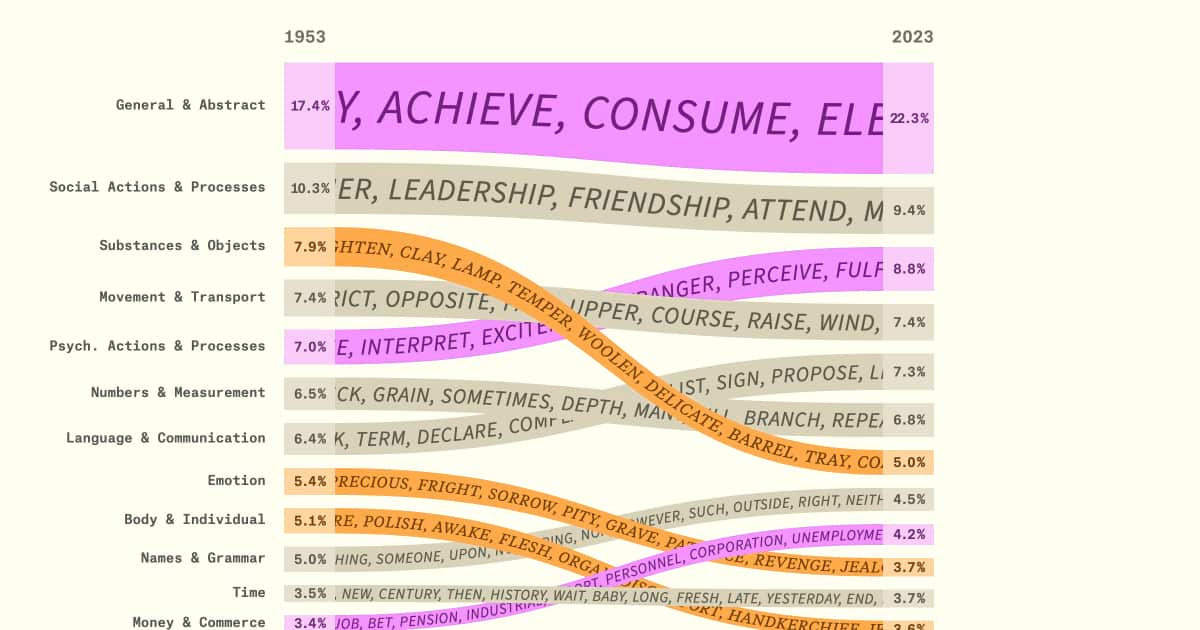
I started by using a common linguistics research tool3 that sorted all of the words by meaning. It assigned each word to one of 21 subject categories, based on typical usage: Food and Farming, the Body and the Self, Government and Public, Language and Communication, and so on. Together, they suggested what kind of world each list was built for.
Discussion (0)
Sign in to join the discussion. Free account, 30 seconds — email code or GitHub.
Sign in →No comments yet. Sign in and be the first to say something.