Laguna S 2.1
Mirrored from Hacker News — AI on Front Page for archival readability. Support the source by reading on the original site.
- Punching above its weight class
- A closer look at DeepSWE
- Evaluation methodology
- Seeing the model work
- Thinking effort
- Limitations
- What actually changed in this model
- A strong base, then new post-training
- Distribution of post-training tasks
- What changed in the training loop
- The bets we're making
- Three models in three months
- Get started
Table of contents
Today we’re releasing Laguna S 2.1, a significant step forward in our development of models that pursue longer horizon work and make effective use of reasoning.
Laguna S 2.1 is a 118B total parameter Mixture-of-Experts (MoE) model with 8B activated parameters per token and supports a context window of up to 1M tokens in thinking and no-thinking modes. It went from the start of training to launch in under nine weeks, and on long-horizon coding benchmarks it holds its own against models many times its size. For every benchmark score we publish today, we are releasing full trajectories for every trial in the final evaluation set at trajectories.poolside.ai.
- Laguna S 2.1 118B-A8B
- Tencent Hy3 295B-A21B
- Inkling 975B-A41B
- Nemotron 3 Ultra 550B-A55B
- DeepSeek-V4-Pro-Max 1.6T-A49B
- Kimi K3 2.8T-A50B
- Qwen 3.7 Max —
- Muse Spark 1.1 —
- Claude Fable 5 —
Terminal-Bench 2.1
SWE-Bench Multilingual
SWE-Bench Pro (Public Dataset)
DeepSWE
SWE Atlas (Codebase QnA)
Toolathlon Verified
Laguna S 2.1 (118B-A8B) |
Tencent Hy3 (295B-A21B) | Inkling (975B-A41B) | Nemotron 3 Ultra (550B-A55B) |
DeepSeek-V4-Pro Max (1.6T-A49B) |
Kimi K3 (2.8T-A50B) | Qwen 3.7 Max (—) |
Muse Spark 1.1 (—) |
Claude Fable 5 (—) |
|
|---|---|---|---|---|---|---|---|---|---|
Terminal-Bench 2.1 |
70.2 | 71.7 | 63.8 | 56.4 | 64.0 | 88.3 | 74.5 | 80 | 88.0 |
| SWE-Bench Multilingual | 78.5 | 75.8 | - | 67.7 | 76.2 | - | 78.3 | - | - |
| SWE-Bench Pro (Public Dataset) | 59.4 | 57.9 | 54.3 | - | 55.4 | - | 60.6 | 61.5 | 80.3 |
| DeepSWE | 40.4 | - | - | - | 9.0 | 69.0 | - | 53.3 | 70.0 |
| SWE Atlas (Codebase QnA) | 46.2 | - | - | - | 27.2 | - | - | 42.2 | - |
| Toolathlon Verified | 49.7 | - | 45.5 | 34.3 | 55.9 | - | - | 75.6 | - |
Punching above its weight class
Laguna S 2.1 is, as far as we can measure, the most capable agentic coding model in its weight class by a wide margin.
S 2.1 scores 70.2% on Terminal-Bench 2.1 in our agent harness with thinking enabled. Its compact size makes it uniquely suitable for complex work on local machines.
- Open weights
- Closed / size undisclosed
- 1 GPT-5.6 Sol 88.8
- 2 Kimi K3 2.8T-A50B 88.3
- 3 Claude Fable 5 88.0
- 4 GPT-5.6 Terra 87.4
- 5 GPT-5.6 Luna 84.7
- 6 Claude Opus 4.8 84.6
- 7 Claude Sonnet 5 80.4
- 8 Muse Spark 1.1 80.0
- 9 Qwen-3.7 Max 74.5
- 10 Hy3 295B-A21B 71.7
- 11 Laguna S 2.1 118B-A8B 70.2
- 12 MiniMax M3 428B-A23B 66.0
- 13 DeepSeek-V4-Pro-Max 1600B-A49B 64.0
- 14 Inkling 975B-A41B 63.8
- 15 DeepSeek-V4-Flash-Max 284B-A13B 61.8
- 16 Nemotron 3 Ultra 550B-A55B 56.4
- 17 Inkling-Small 276B-A12B 52.7
- 18 Qwen3.6-27B 27B 51.3
- 19 Qwen3.6-35B-A3B 35B-A3B 44.9
- 20 Nemotron 3 Super 120B-A12B 38.6
- 21 Laguna XS 2.1 33B-A3B 33.4
- 22 Mistral Small 4 119B 21.4
Terminal-Bench 2.1 evaluates a wide, high-quality set of long-horizon tasks where an agent model is connected to its environment through a terminal. Laguna S 2.1 is a standout model in its size category on this benchmark.
- Laguna S 2.1
- Other Laguna
- Other disclosed models
A closer look at DeepSWE
The benchmarks above are all meaningful, and we're glad to be close to the frontier on them. But part of that closeness is a property of maturing benchmarks: as the frontier advances, top scores cluster in the 70-90% range and models that behave very differently end up no more than a few points apart. Datacurve’s DeepSWE still has significant headroom. Its tasks are longer-horizon and hard to partially solve, and the scores actually spread: frontier models range from 54% to 73% on the v1.1 variant, with some 1T+ parameter open models scoring below 10%.
On DeepSWE v1.1, Laguna S 2.1 scores 40.4 in thinking mode in pool harness.
- Open weights
- Closed / size undisclosed
- 1 GPT-5.6 Sol 73.0
- 2 Claude Fable 5 70.0
- 3 GPT-5.6 Terra 70.0
- 4 Kimi K3 2.8T-A50B 69.0
- 5 GPT-5.6 Luna 67.2
- 6 GPT-5.5 67.0
- 7 Claude Opus 4.8 59.0
- 8 Claude Sonnet 5 54.0
- 9 Grok 4.5 54.0
- 10 Muse Spark 1.1 53.3
- 11 GPT-5.4 52.0
- 12 GLM 5.2 753B-A40B 44.0
- 13 Laguna S 2.1 118B-A8B 40.4
- 14 Gemini 3.5 Flash 37.0
- 15 Kimi K2.7 Code 31.0
- 16 Claude Sonnet 4.6 30.0
- 17 Gemini 3.1 Pro 12.0
- 18 DeepSeek-V4-Pro-Max 1600B-A49B 9.0
- 19 Laguna XS 2.1 33B-A3B 0.3
It is worth noting that Laguna S 2.1 scored 40.4% in our agent harness, pool, not mini-swe-agent which DeepSWE’s leaderboard uses. For other models we report maximal over reported scores which for most models are the official leaderboard results reported by Datacurve. While this makes scores less comparable, we don’t believe it puts us in a particularly advantageous position as it’s been reported that many of the models score the same or better in mini-swe-agent compared to their native harnesses. Every trajectory in the final evaluation run is available here.
Evaluation methodology
Evaluation of agent models is notoriously difficult due to prevalence of reward hacking. We have previously written about reward hacking in leading benchmarks and our evaluations system and rigor as part of the technical report on our Laguna M.1 and XS.2 models. Recent work has focused on adversarial judging to increase reward hacking detection.
With this release, we are making all trajectories from our final evaluations of the published Laguna S 2.1 checkpoint available to view and download at trajectories.poolside.ai.
Seeing the model work
Benchmark scores give a quantitative view into the model behavior, but to get a better intuitive understanding of how the model works it’s useful to look into runs on real world tasks. We share three such tasks with unedited trajectories and commentary.
Case study 1
A browser engine from a blank folder
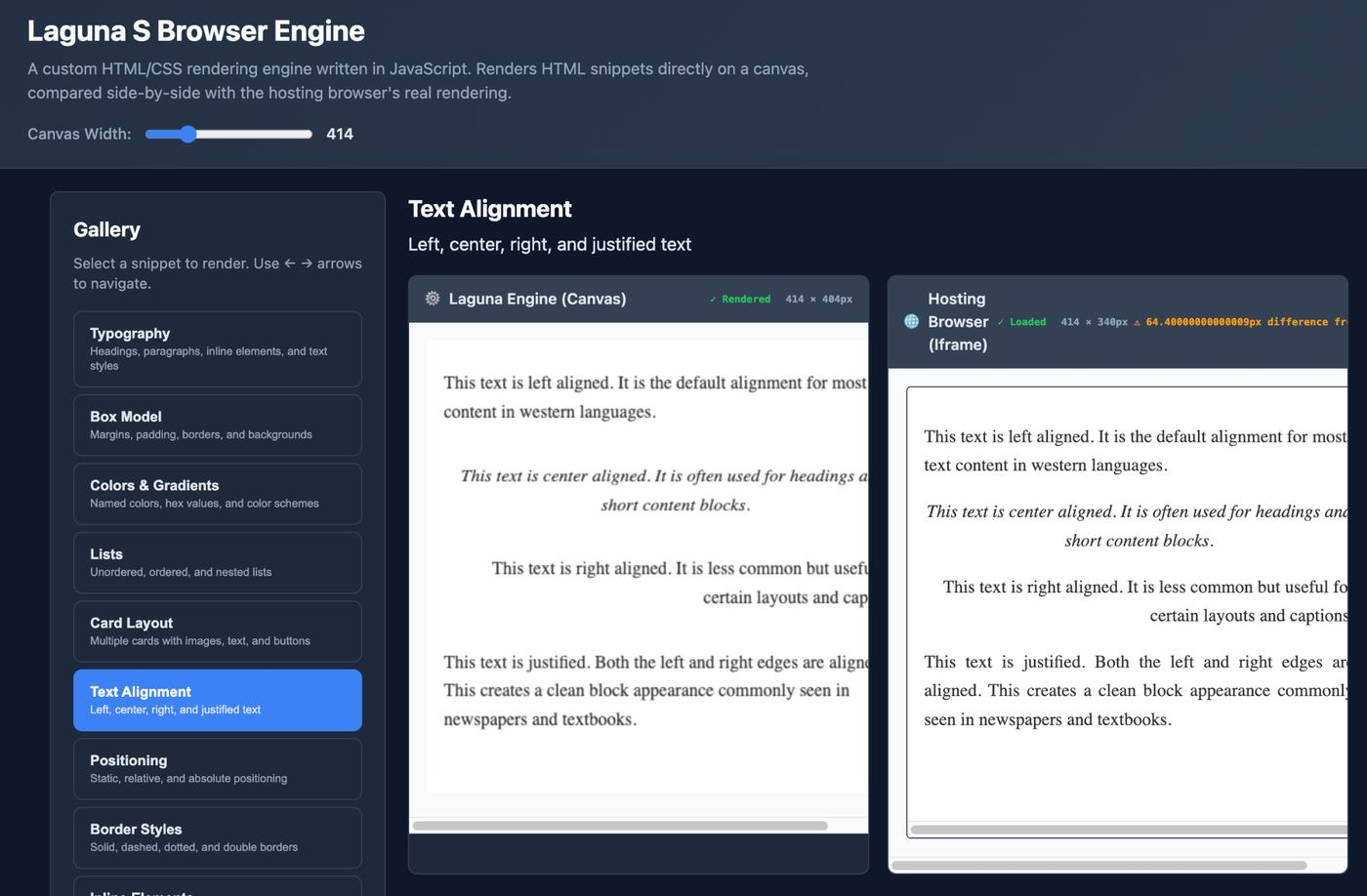
One of our favorite things about Laguna S 2.1 is its resourcefulness: It will find clever ways to get to the goal even if the direct path is not available. We saw a great demonstration of this when we asked it to build a browser engine from scratch; knowing it would be a challenge for Laguna to verify its work given its lack of vision capabilities. In one 50-minute session of 181 steps, with no human intervention, Laguna S 2.1 built a working HTML/CSS rendering engine from an empty folder, then proved it renders like a real browser by measuring itself against one. Throughout its work, the model found increasingly complex ways to validate its work despite its limitations, leading to running headless Chromium to read canvases back and comparing screenshots numerically. See the full trajectory here.
Read the full case study// the verbatim prompt · reproduce it yourself
your job is it to build a simple browser engine (just html/css) in
javascript to demonstrate the capabilities of poolsides new "Laguna S"
model. the goal is to take render html snippets in a canvas like a real
browser. to demonstrate it the engine, build a self-contained single
page app that showcases a gallery of multiple html snippets and renders
them side by side (canvas with our render engine + iframe letting the
hosting browser render it for real for comparison). support for most
common layout and styling elements
Over the session the model built the full pipeline, parser → cascade → layout → renderer, in vanilla JavaScript: an HTML tokenizer and DOM tree, a CSS parser with selector specificity, a cascade engine with inheritance, box-model layout, and a canvas-2D renderer, wrapped in an app that shows nine snippets on its own canvas beside the same markup in an iframe, so the hosting browser sits right there as the reference.
Discussion (0)
Sign in to join the discussion. Free account, 30 seconds — email code or GitHub.
Sign in →No comments yet. Sign in and be the first to say something.