Building a general-purpose accessibility agent—and what we learned in the process
Mirrored from GitHub Blog — AI & ML for archival readability. Support the source by reading on the original site.
It is an understatement to say agents have become a popular way of working with code. GitHub has adopted agent-based code creation and editing for many of its initiatives, including piloting an agent to help with our commitment to accessibility.
GitHub is currently piloting an experimental general-purpose accessibility agent to achieve two main goals:
- Providing engineers with reliable, just-in-time answers to accessibility questions in the GitHub Copilot CLI and the Copilot VS Code integration.
- Catching and automatically remediating simple, objective accessibility issues before they go to production.
For purpose number two, the accessibility agent is set to automatically evaluate changes that modify our front-end code.
To date, the agent has reviewed 3,535 pull requests, with a 68% resolution rate. In order of occurrence, the top five issue types center around:
- Making structure and relationships clear to assistive technologies
- Providing clear and concise names for interactive controls
- Ensuring users are aware of important announcements
- Ensuring there are text alternatives for non-text content
- Moving keyboard focus through pages and views in a logical order
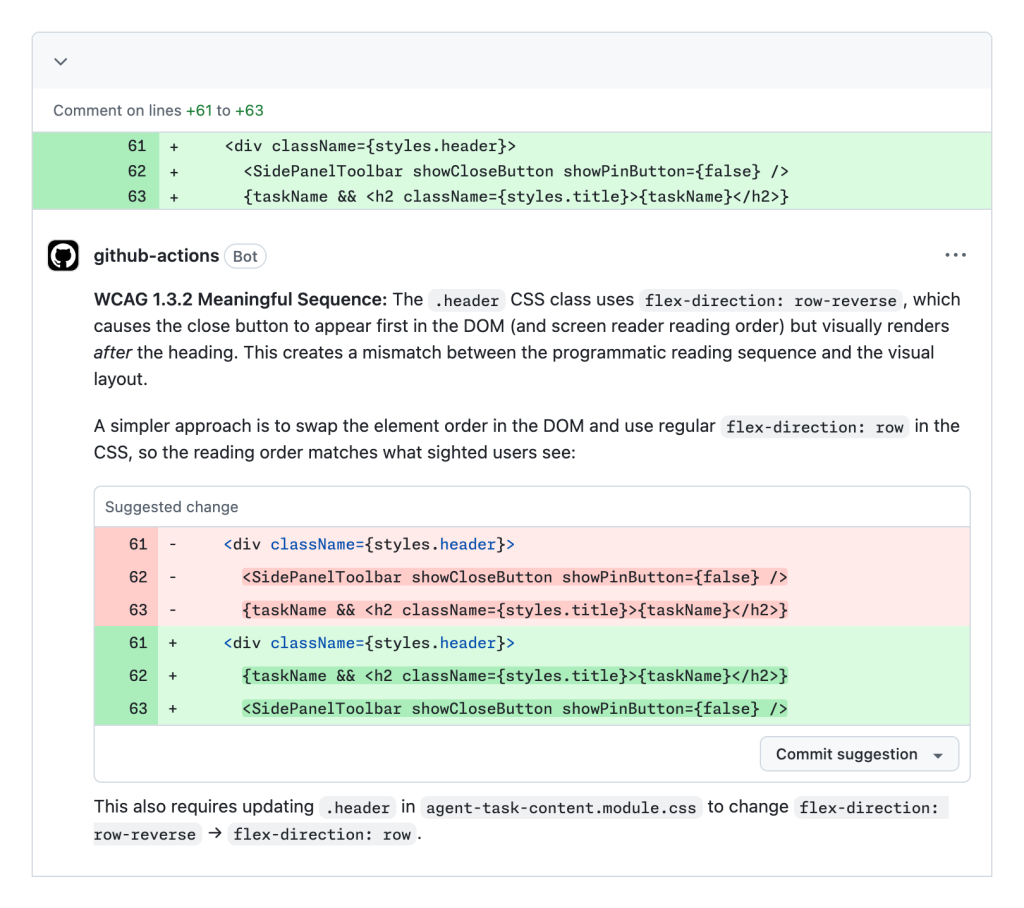
Each of these issue types represents friction and barriers automatically removed that would have otherwise inhibited use of GitHub for people who use and rely on assistive technology. Here’s a screenshot of it in action:
Interested? We’ll be outlining successes and lessons learned with this experiment, with the hopes that it can help with other teams’ accessibility journeys.
What are LLMs and agents?
Note: This post assumes at least some understanding of LLMs, agents, and their related concepts. If you’re not familiar, you can learn more about LLMs on our blog.
Some specific posts you may find helpful are:
- A guide to deciding what AI model to use in GitHub Copilot
- GitHub for Beginners: How to get LLMs to do what you want
- How to write a great agents.md: Lessons from over 2,500 repositories
- Multi-agent workflows often fail. Here’s how to engineer ones that don’t.
Mindset
The social model of disability teaches us that access barriers—and consequently impairment—can be created because of how an environment is built. The same thinking applies to digital experiences.
With the accessibility agent, we are not attempting to “solve” accessibility in isolation. We are instead attempting to augment our peers’ efforts, to better help them remove the barriers that may be created as a result of how we construct GitHub’s user interfaces.
The accessibility agent is not a “silver bullet” that can automatically address every hypothetical scenario. Understanding, honoring, and socializing this better helps set the agent’s scope of responsibility. This sped up the experiment’s launch, leading to more buy-in for the effort.
Past efforts
The European Accessibility Act is now in effect. Title II of the Americans with Disabilities Act is set to establish meeting WCAG 2.1 AA as the legal definition of done in April of 2027. LLM agents can read and take action on the accessibility tree.
To say it plainly: Organizations will be at a disadvantage if they have not already invested in manually identifying and remediating accessibility issues. There are many reasons for this, including building an accessibility agent.
To that point, GitHub has a mature system in place for logging accessibility issues, as well as verifying fixes to issues are working as intended. This includes:
- A structured template for reporting problems
- Steps to reproduce the issue
- A rich layer of metadata about the issue’s severity level, service area, and applicable WCAG success criterion
- Crosslinks to the Pull Request that addressed the issue
- Acceptance criteria
In addition, all the issues are centralized to a single repository. While this issue-logging effort predated the explosion in popularity of LLM tooling, its highly consistent and structured nature made it an ideal corpus of content for the accessibility agent to reference.
Because of this, we instructed the agent to investigate these issues to see if there are related code and language snippets it can extrapolate from. This is one area where the non-deterministic “fuzzy matching” behavior of LLMs acts as an asset rather than a possible liability.
Old gold
Much like with any other specialized domain area, vague instructions in a skill file won’t cut it. Telling an LLM to “use accessibility best practices” with a short list of examples won’t work well.
When generating code, LLMs have an unfortunate bias towards producing accessibility antipatterns since every major LLM currently available is trained on decades of inaccessible code.
To counteract this, the agent needs better content to draw from.
So, I enthusiastically recommend investing in manually cataloging and remediating accessibility issues. After some progress, this data can be incorporated into the agent.
The issues and their corresponding pull requests provide highly contextual examples for the LMM to reference, written using the conventions set up by the organization it is deployed in. This collection of issues and code is by far one of the strongest assets the agent draws from.
Efficient token consumption
Accessibility is a holistic concern, intersecting with code, design, copywriting, and numerous other disciplines involved with creating user interfaces.
A lot of accessibility work is also highly contextual, meaning that someone typically needs the full working picture of a problem before they’re able to give the appropriate advice for what to do.
Because of these two factors, a general-purpose accessibility agent can consume a ton of tokens when it performs work. This has three negative outcomes:
- An increased amount of unreliable output
- Slower response times
- Increased operational costs
It’s important to be diligent when structuring the agent. Here’s how we went about doing just that.
Use sub-agents
The accessibility agent started as a single monolithic agent, but quickly grew past the limitations of this approach. Because of this, we evolved it to use a sub-agent architecture.
A lot of guides recommend creating a large suite of sub-agents, each with its own specific area of responsibility. Here, the sub-agents are executed in parallel, with the main agent reconciling their output.
Surprisingly, this approach worked against us for the accessibility agent. Instead, we wound up using two dedicated sub-agents:
- The first sub-agent acts as a passive reviewer and researcher.
- The second sub-agent acts as an active implementer.
The two sub-agents are sandboxed and cannot directly pass content to each other. Instead, they generate a structured, templatized output. This output is then served to the parent orchestrating accessibility agent to consume, validate, and route.
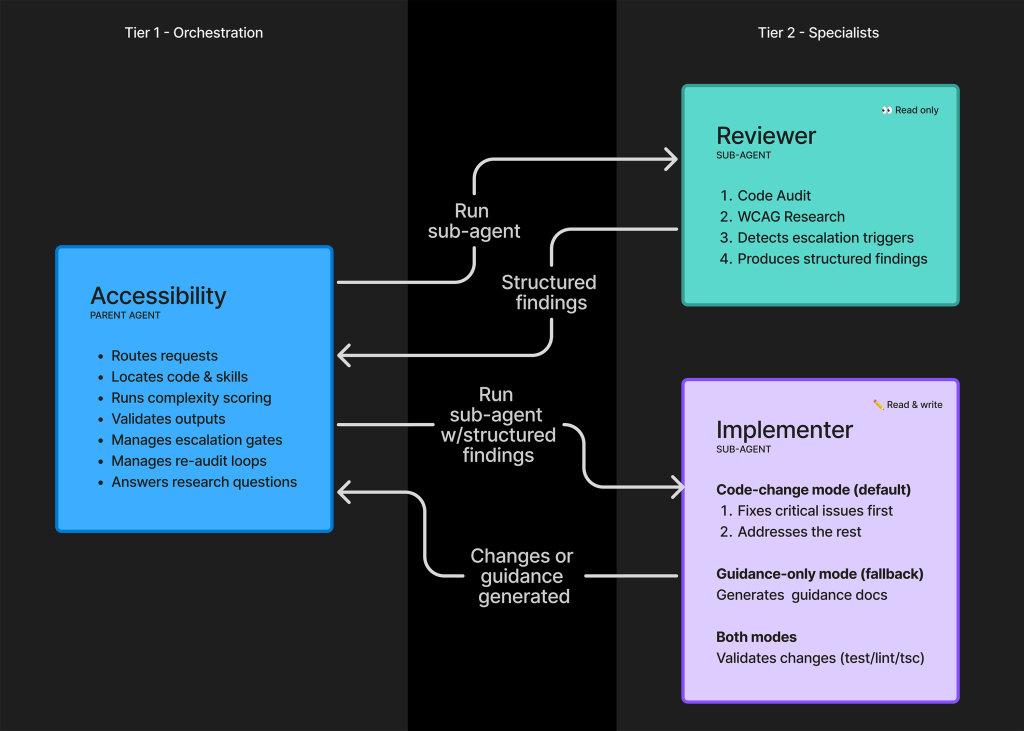
There are a few reasons for this approach:
- Escalation checkpoints. The reviewer checks for areas where human intervention will likely be needed. This includes multiple high-severity WCAG failures, as well as a list of patterns that are known to be difficult to make accessible.
- Complexity-based behavior. The agent is instructed to operate in a specialized guidance-only mode if the underlying code is deemed too complicated. Here, the parent accessibility agent acts as an arbiter, while the reviewer agent is “opinionless” and just reports the findings as instructed.
- Filtering. The reviewer presents everything it finds. The parent accessibility agent then utilizes resources and skills to determine what is relevant to the request. The reviewer passing all its findings to the implementer would be costly and potentially set it on irrelevant and counter-productive tasks.
- Traceability. Direct communication between sub-agents would remove the ability to create and review an audit trail of user and agent decisions. This is important given the agent’s instruction around complex patterns, as well as the highly contextual nature of accessibility work.
Execute instructions in a linear order
In addition to being a holistic concern, effective digital accessibility work also demands a methodical, detail-oriented approach.
The concern of using sub-agents to increase the speed of the LLM’s reply is counterbalanced by our need for its results to be accurate. We found that compelling the agent to execute its sub-agent instructions in a fixed order was key.
We first establish a parent set of ordered phases. Each phase itself contains child ordered steps of instructions, which are accompanied by relevant resources and skills:
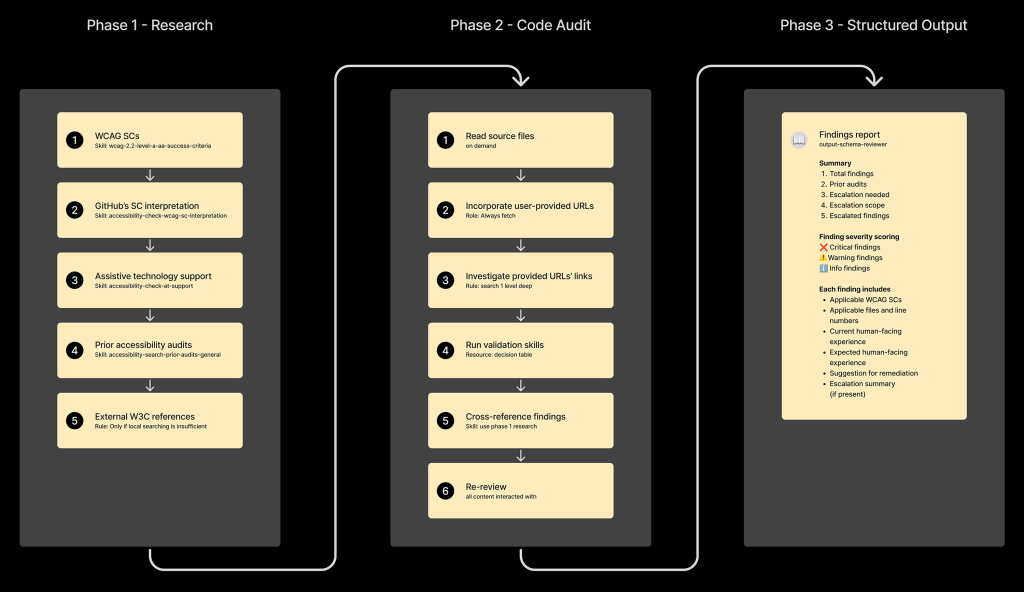
The interesting bit about this linear order is that it mirrors how I would personally approach performing auditing, remediating, and reporting duties.
Use a template schema pass around sub-agent content
The entire operation of the sandboxed sub-agents is built around template schema files. These files create consistency that is vital to keeping the agent focused and on track.
The two schema templates are:
- Reviewer template schema: This focuses on what to audit, and how to find applicable information about it.
- Implementer template schema: This focuses on what to fix and how to fix it.
Without the schema files in place, the agents would all attempt to arbitrarily communicate with each other. This would create increased token expenditure, undesirable hallucinations, unnecessary code changes, and difficult-to-impossible behavior for agent auditing purposes.
Acknowledging limitations
Another vital aspect of creating the accessibility agent is understanding areas where agents can fall short.
As the agent is not a turnkey “solution” for accessibility, we want to avoid situations where the agent’s output in error may not be sufficiently interrogated by the human using it. This is especially relevant when someone is not well-versed in digital accessibility considerations and practices.
Here’s what we did to accommodate the agent’s limitations:
Evaluate code complexity
We want to avoid scenarios where we would need to perform costly and time-intensive work to revisit an inaccessible solution that the agent “thinks” is accessible.
To aid with this problem, the accessibility agent uses a small shell script to analyze the code it is set to work on. The script itself is simple, using a small set of basic heuristics to evaluate the relative complexity and distill it down into a score.
This score is then ingested by the agent. If the score passes a set threshold, the agent is instructed to not execute code changes. Instead, it will inform the person using the LLM that they should reach out to the accessibility team to consult on what they are attempting to do.
Identify high-risk patterns
It is a subtle thing to understand, but know that it is entirely possible to have code that passes automated accessibility checks, yet is functionally unusable.
As a companion to code complexity, the accessibility agent is instructed to avoid attempting code generation for patterns the accessibility team has identified as high-risk. This includes, but is not limited to: drag and drop, toasts, rich text editors, tree views, and data grids.
These patterns require a ton of focused attention and detail and currently sit outside of an LLM’s current capabilities to produce in a way that actually works with assistive technology.
Not prohibiting high-risk patterns and high-complexity code environments would lead to unnecessary demands of everyone’s time to readdress, and also represents reputational risk for the accessibility team. We avoid this by shutting off the LLMs capability to go down this pathway.
Reduce bias to action
I am loathe to anthropomorphize LLMs, but one quality they all seem to share is desperately wanting to produce content. For Copilot, that often means generating code.
We had to create anti-gaming instructions to prevent the LLM from creating sneaky ways to get around its instructions to not generate code when human expertise is needed. This prevented it from violating its own intervention instructions.
Know that programmatically determinable issues don’t cover everything
Agent success metrics live within a larger context.
Of the 55 total WCAG level A and AA Success Criterion, only 35 of them can be detected via deterministic automated code checkers. This means that ~36% of level A and AA Success Criterion cannot be discovered automatically.
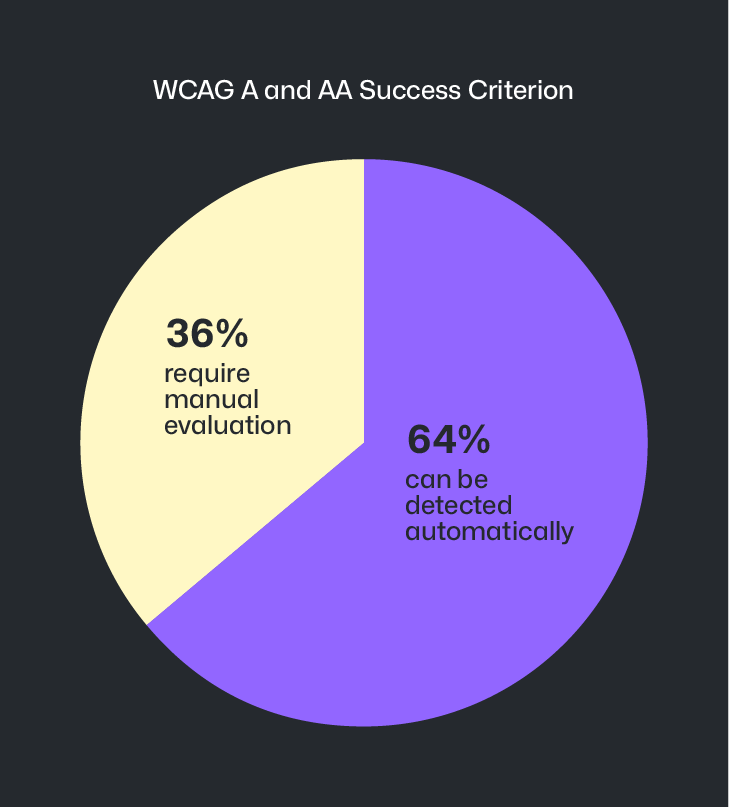
LLM-powered agent operation is making inroads on this ~36% gap, but it is not a perfect science. Because of this, it becomes important to manually identify accessibility barriers earlier during design and prototyping efforts—the area where the majority of accessibility issues originate.
This thinking is also reflected in the agent’s escalation logic, in that members of the Accessibility team can pair with designers to help consider alternate approaches and brainstorm solutions that achieve business goals without compromising on accessibility.
This intervention and assistance is done to thwart potential downstream issues—and costly and time-consuming redesigns—are stopped before they ever have a chance to get off the ground.
Manually evaluate agent output and adjust things that aren’t working as expected
We periodically perform manual review of agent output to determine its accuracy and efficacy. In addition, we have tooling in place to capture pull request reviewer sentiment. Both serve as strong signals for areas where the agent needs better instruction, as well as new resources and skills.
Learning in the open
To recap, we learned that the agent is:
- Used to aid and augment existing accessibility efforts, not to replace them.
- Significantly more effective when trained on manually audited and remediated accessibility issues for your specific experience.
- Far more efficient with token consumption when utilizing sub-agents.
- More accurate and effective when executing instructions in a methodical, linear fashion.
- More consistent when set to use preformatted templates to pass information around.
- Set to understand its limitations and route people to alternative support systems.
- Improved when its output is periodically reviewed to identify areas it needs better instruction.
This journey is also not yet complete. The accessibility agent continues to be iterated upon in the hopes of helping ensure GitHub is an accessible and inclusive platform for all developers.
We hope that we can eventually open source the agent as part of our pledge to help improve the accessibility of open source software at scale. Until then, we hope that in sharing our learnings with this undertaking that other teams can have a resource to reference for their own accessibility efforts.
The post Building a general-purpose accessibility agent—and what we learned in the process appeared first on The GitHub Blog.
Discussion (0)
Sign in to join the discussion. Free account, 30 seconds — email code or GitHub.
Sign in →No comments yet. Sign in and be the first to say something.